


Samsung Electronics' 360 Trillion Won Investment to Create World's Largest 'Yongin Advanced System Semiconductor National Industrial Park', Receives Final Approval from Ministry of Land, Infrastructure and Transport
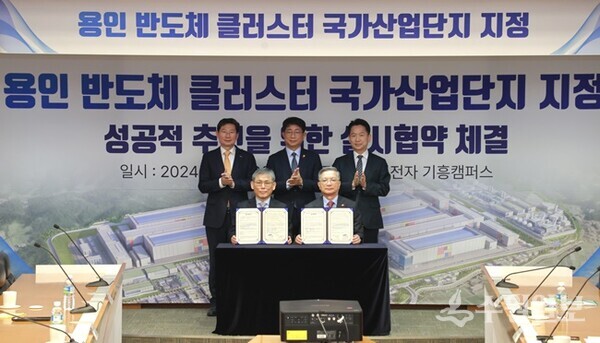
[Suwon Ilbo=Reporter Choi Ki-ho] Yongin Special City announced on the 26th that the Ministry of Land, Infrastructure and Transport has granted final approval for the Advanced System Semiconductor Cluster National Industrial Park in Idong and Namsa-eup, Cheoin-gu.
The approval of the national industrial park, which had been scheduled for the first quarter of next year, was completed approximately three months earlier, giving momentum to the development of the industrial park.
At the 'Yongin Advanced System Semiconductor National Industrial Park Approval Ceremony' held at Samsung Electronics Giheung Campus in Nongso-dong, Giheung-gu, Yongin City on that day, along with the Ministry of Land, Infrastructure and Transport's approval of the national industrial park, an implementation agreement containing the details of the land purchase and sale contract between Korea Land and Housing Corporation (LH), the business operator, and Samsung Electronics was concluded.
The event was attended by Park Sang-woo, Minister of Land, Infrastructure and Transport, Yongin Mayor Lee Sang-il, LH President Lee Han-jun, Samsung Electronics President Kim Yong-gwan, and Gyeonggi Province Deputy Governor for Economic Affairs Ko Young-in.
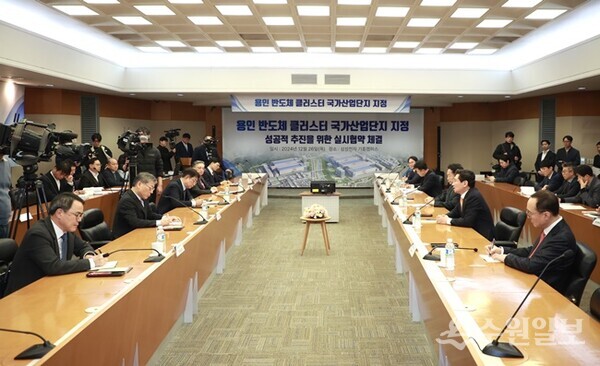
The Ministry of Land, Infrastructure and Transport announced a specialization development plan for the 'Yongin Advanced System Semiconductor National Industrial Park' at the ceremony, and LH explained detailed plans for site development following the approval of the national industrial park.
The Ministry of Land, Infrastructure and Transport also announced a plan to develop a relocation industrial park for companies currently located on the national industrial park site.
Accordingly, Yongin City plans to add approximately 500,000 square meters (approximately 150,000 pyeong) in the area of Wanjang-ri and Chang-ri, Namsa-eup, Cheoin-gu to the restricted development area, and will conduct resident review for the changed area in order to expand the area boundaries of the 'Advanced System Semiconductor National Industrial Park'.
With the establishment of a relocation industrial park for companies and its incorporation into the national industrial park, the scale of the 'Yongin Advanced System Semiconductor National Industrial Park' will be expanded to approximately 7.78 million square meters (approximately 2.35 million pyeong).
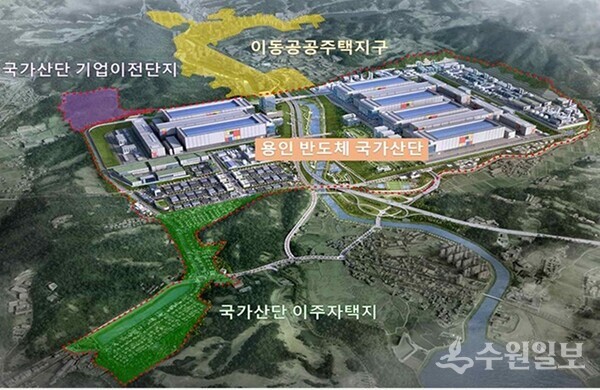
The 'Yongin Advanced System Semiconductor National Industrial Park', selected as a candidate for a national industrial park in March last year, will house six Samsung Electronics semiconductor production lines (fabs), and will accommodate approximately 150 companies in semiconductor materials, parts, equipment, and design sectors.
This will create the world's largest semiconductor cluster with Samsung Electronics investing 360 trillion won, equivalent to Yongin City's century-long budget, and when the project is completed, it is expected to become the top center of the Republic of Korea's semiconductor industry.
Mayor Lee Sang-il said at the ceremony, "Yongin Special City, where the Republic of Korea's semiconductor industry began earliest, has worked closely with the Ministry of Land, Infrastructure and Transport, LH and others to successfully develop the 'Yongin Advanced System Semiconductor National Industrial Park', and we welcome the fact that approval of the national industrial park has been granted earlier than originally planned," and added, "Early approval of the national industrial park is a highly desirable development for the progress of the semiconductor industry, where speed is the essence, and the strengthening of competitiveness of related companies. Going forward, close cooperation among relevant agencies must continue to operate smoothly to proceed with the remaining processes expeditiously."
Mayor Lee said, "There has been some gossip among certain circles suggesting that 'Samsung Electronics' investment could decrease' or 'the development of the national industrial park may not proceed well,' but such rumors and speculation are expected to be dispelled with the early approval of the national industrial park."
Mayor Lee said, "The key to swift and successful development of the national industrial park is the smooth progress of land compensation and relocation of residents and businesses," and added, "It is greatly welcome that the Ministry of Land, Infrastructure and Transport has confirmed the relocation business industrial park site following consultation with the city on residential relocation sites, but there remain tasks ahead."
He continued, "I would like the government to actively review issues that I have emphasized at every national industrial park meeting, such as reasonable compensation for relocating residents and businesses, transfer tax exemptions related to compensation, corporate tax reductions for relocating businesses, and policy funding support, so as to help relocating residents and businesses."
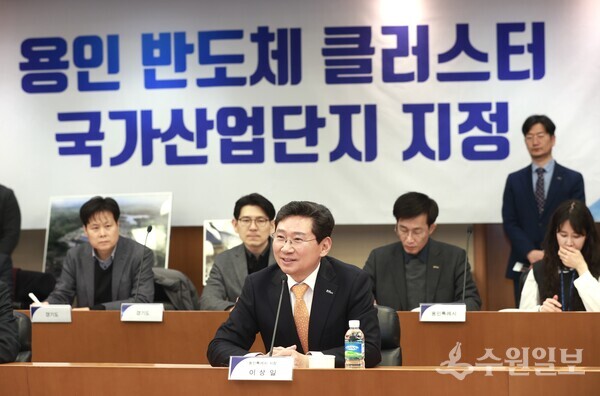
Mayor Lee also stated, "As the national industrial park project will be completed, the estimated number of resident workers working within the park will reach approximately 103,000 people, so it is very important to provide good living conditions and commuting environments for these talented individuals," and requested, "We ask the Ministry of Land, Infrastructure and Transport to continue supporting momentum for the development of a semiconductor-specialized new city in Idong-eup, Yongin, and to make sure to reflect the Gyeonggang Line extension (Gwangju Station, Gyeonggi Province to Idong and Namsa-eup, Yongin) and the new Gyeonggi Southern Metropolitan Railway (Jamsil Sports Complex Station, Seoul to Pangyo, Seongnam to Shinbong and Seongbok-dong, Yongin to Gwanggyo, Suwon to Bongdam, Hwaseong) in the 5th National Railroad Network Construction Plan scheduled to be drawn up next year."
Since taking office in 2022, Mayor Lee has created ordinances and organizations for nurturing the semiconductor industry in Yongin.
In March last year, Samsung Electronics secured the Advanced System Semiconductor National Industrial Park, which is investing 360 trillion won, and last November, he also led the government's decision to develop a semiconductor-specialized new city in Idong-eup.
After the announcement of the national industrial park development, the government established residential sites for residents within the industrial park site with an area of approximately 368,160 square meters (110,000 pyeong) in the Chang-ri area, Namsa-eup, Cheoin-gu last year, and this time has confirmed a space for relocating businesses.
Information on the relocation business industrial park to be developed in an area of approximately 500,000 square meters (approximately 150,000 pyeong) in Wanjang-ri and Chang-ri, Namsa-eup, Cheoin-gu can be found on the city's website (https://www.yongin.go.kr/).
This space for relocating businesses will be added to the restricted development area and will be subject to resident review. Once designated and announced as a restricted development area, building construction, expansion or renovation, land formation changes, and excavation of soil and stone will be restricted from the designation date until April 12, 2026.
However, emergency measures for disaster recovery and disaster relief, installation of structures directly used in the production of agricultural and aquatic products such as vinyl greenhouses, sericulture facilities, and red pepper drying houses, and land formation changes for farming purposes that do not require change of land category are excluded from the restricted areas.
Related documents on the restricted development area designation can be inspected from December 27 to January 16 of next year by visiting the Yongin Special City Hall Semiconductor National Industrial Park Division or the Korea Land and Housing Corporation Yongin Semiconductor National Industrial Park Project Division.
Meanwhile, a 12.7-kilometer section of 'National Route 45' running through the Idong and Namsa-eup Advanced System Semiconductor National Industrial Park and the Idong-eup semiconductor-specialized new city, from Daechon Interchange, Namdong, Cheoin-gu to Jangso Interchange, Yangseong-myeon, Anseong City, will be expanded from four lanes to eight lanes. The city has persistently requested and obtained an exemption from preliminary feasibility studies from the Ministry of Land, Infrastructure and Transport and the Ministry of Strategy and Finance for the prompt implementation of this project, which will require approximately 1.1 trillion won in investment.
The city expects that the expansion project on this section of National Route 45, where traffic congestion is severe during commuting hours, will be completed by the second half of 2030, when Samsung Electronics' first semiconductor production line (fab) becomes operational, with the completion schedule advanced by more than three years due to the preliminary feasibility study exemption.

Loading comments…