


Two out of Five Single-Person Households in Suwon Want to Marry Their Ideal Partner
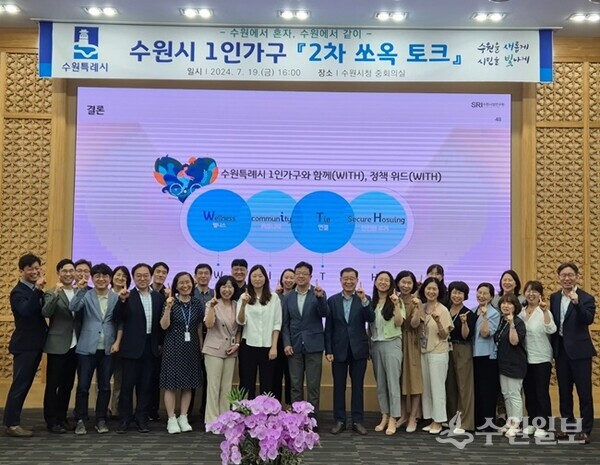
[Suwon Ilbo=Reporter Jung Jun-sung] Two out of five single-person households in Suwon Metropolitan City expressed a desire to marry their ideal partner.
This was revealed in the actual conditions survey findings presented by the Suwon Metropolitan City Research Institute at the "2nd SsOcC Talk (Forum) for Suwon City Single-Person Household Support Projects" held on the 19th in the City Hall conference room to discuss measures for developing new single-person household policies and projects. The forum was attended by Kim Hyun-soo, First Vice Mayor of Suwon City, departments of the Single-Person Household Comprehensive Control Tower, and heads of relevant organizations.
The Suwon Metropolitan City Research Institute conducted an actual conditions survey across nine areas—including economy, welfare, housing, and policy demands—targeting 1,075 single-person households aged 19 and over residing in Suwon from March 28 to April 24. The results showed that 40.8% of respondents answered, "I want to meet my ideal partner and get married." Among them, 49.7% of men and 30.3% of women wanted to marry, while 24.2% of men and 39.9% of women preferred to "continue living alone as they do now."
The survey was conducted through a combination of mobile and in-person methods. The respondent demographics were 54.3% male and 45.7% female, with age distribution of 24.4% in their 20s, 23.1% in their 30s, 14.2% in their 40s, 13.4% in their 50s, and 24.9% aged 60 and over.
Male, young, and unmarried single-person households showed relatively higher proportions desiring to marry their ideal partner and live together. Female, older-aged, and separated or widowed single-person households more frequently answered that they preferred to "continue living alone as they do now."
62.5% of single-person households cited voluntary reasons and 36.3% cited involuntary reasons for living alone. Among "voluntary" reasons, "distance from workplace or school" was the highest at 34.9%, followed by "personal convenience and freedom" at 18.4%.
92.3% of respondents answered there are "advantages to living alone," with "freedom in lifestyle and decision-making" being the most common at 73.3%. 91.8% also answered there are "difficulties," citing "difficulty coping when sick or in emergencies" (44.8%) and "economic hardship" (21%) as main reasons.
Analysis by age group revealed that young single-person households have high quality of life and work capacity but low housing stability, middle-aged and older single-person households show high heterogeneity within the generation and relatively vulnerable mental health, and elderly single-person households face difficulties due to multiple forms of frailty.
The Suwon Metropolitan City Research Institute proposed policy directions for single-person households: △Young adults—establish housing safety net, provide emotional recovery support △Middle-aged and older adults—economic support, build care networks △Prevent social isolation, manage health, etc.
Department heads and organization leaders attending the forum agreed to reexamine existing single-person household support projects based on the survey findings and cooperate in discovering new projects for 2025 through policy idea meetings.
First Vice Mayor Kim Hyun-soo said, "Based on the survey findings, I ask the comprehensive control tower departments to cooperate in developing policies that single-person households can feel," and "We will create a city where single-person households can live safely and comfortably."
Meanwhile, SsOcC is a brand for Suwon City's single-person household support projects, derived from the first letters of 'Suwon safe One convenience Connect.' It represents the city's commitment to supporting single-person households so they can live with peace of mind, convenience, and connection.


Loading comments…