


Mayor Lee Sang-il of Yongin Requests Government Support for Welfare and Environmental Projects
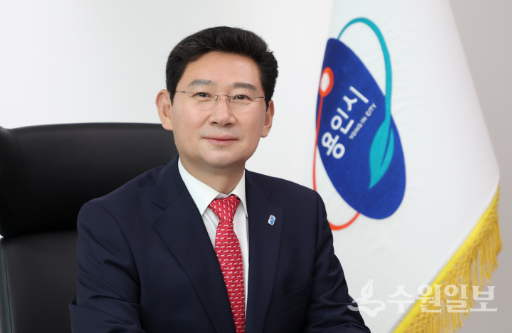
[Suwon Ilbo=Reporter Choi Ki-ho] Mayor Lee Sang-il of Yongin Special Status City met on the 19th with Jang Sang-yoon, Presidential Secretary for Social Affairs, and delivered briefing materials on 8 current projects across 2 sectors including welfare and environment such as improving the treatment of long-term care workers, requesting government support.
The projects for which the mayor requested support include △differential application of property conditions by region in the sick leave allowance pilot project △improvement of processing deadline compliance for barrier-free living environment certification △improvement of treatment for long-term care workers, and 3 other projects in the welfare sector △cancellation of designation of waterfront areas in Pogok-eup, Cheokin-gu △expedited promotion of deregulation of water source protection areas and factory restriction areas △budget reflection for non-point pollution reduction facility installation projects △government-level support for water supply security △national treasury support for Sanghyeon Respira improvement projects, and 5 other projects in the environmental sector.
The mayor stated through materials related to welfare sector issues, "As Yongin City was selected for Phase 2 of the sick leave allowance pilot project last year, we identified improvements to the system ahead of its nationwide implementation in 2027, and found that the property standard for beneficiaries is uniformly applied nationwide, which is unreasonable," and added "We hope that the property standards will be applied differentially according to local circumstances so that workers in large cities do not fall out of eligibility due to relatively high real estate prices."
The city is conducting a pilot project that provides sick leave allowance to workers aged 15 to under 65 who have been hospitalized for three consecutive days or longer or received outpatient treatment for illnesses or injuries unrelated to work.
Among 1,512 cases consulted from July last year through May of this year, 506 cases failed to meet income and property standards, with only 363 people receiving the allowance. The payment rate compared to consultations was 24%, which falls far short compared to City A located in North Jeolla Province with a payment rate of 66% compared to consultations.
The mayor stated in the materials, "Public buildings such as Seongbok-dong Library and Jung-ang-dong Administrative Welfare Center are taking 21 months to obtain barrier-free living environment certification (BF), causing project delays," and "We must improve the certification processing method to expedite the timeline or designate additional certification agencies to respond agilely to nationwide demand," emphasizing the need for institutional improvement.
The mayor explained the issue of unreasonable treatment of long-term care workers, which he had requested improvement on in January when meeting with Health and Welfare Minister Cho Kyou-hong, and said that expanded support for long-service incentives is necessary.
The mayor stated, "According to the 2022 Gyeonggi Province long-term care worker survey, the average wage for long-term care workers in the province is 1.714 million won, and 95.7% of long-term care workers receive monthly wages below 2 million won," and added "We need to improve the poor wage level of long-term care workers to boost morale and enhance the quality level of long-term care services."
Approximately 600,000 long-term care workers nationwide are employed, with about 11,500 working in Yongin, but due to low wages, the turnover and resignation rates are high. To retain skilled workers, the proposal is to expand long-service incentives for those with 3 or more years of continuous service from 60,000 won to 100,000 won, for those with 5 or more years from 80,000 won to 120,000 won, and for those with 7 or more years from 100,000 won to 150,000 won.
The mayor also urged the government's prompt implementation of 5 environmental sector projects.
First, he emphasized that waterfront areas should be promptly deregulated to resolve the long-held wishes of local residents by lifting the dual regulations on 3.9㎢ (approximately 500 soccer field-sized area) around the Gyeong-an Stream involving military facility protection areas and waterfront areas.
Article 4, Section 2 of the Han River Basin Act stipulates that when the Minister of Environment designates and announces waterfront areas, military facility protection areas should be excluded from waterfront areas, but the Pogok-eup area suffers inconvenience such as restrictions on property rights due to overlapping regulations.
The mayor said, "Military facility protection areas regulate a much wider area than waterfront areas, which are designated to cover areas within 1km of river boundaries, causing greater damage and suffering to residents," and added "Since the Han River Basin Environmental Office's fact-finding investigation was completed in May, we ask the Presidential Office to ensure that the Ministry of Environment promptly proceeds with administrative procedures."
The mayor stated, "In accordance with the 'Yongin Advanced System Semiconductor National Industrial Complex Mutual Cooperation Agreement' signed in April by Yongin City and 8 agencies and companies including the Ministry of Land, Infrastructure and Transport, we decided to completely deregulate the Songtan water source protection area in Pyeongtaek City to help with the smooth development of the national industrial complex," and requested, "We ask that the Ministry of Environment promptly review Pyeongtaek City's application to change the water supply improvement plan so that the water source protection area deregulation proceeds smoothly until the national industrial complex is approved."
Under current procedures, the deregulation of water source protection areas must precede the subsequent process in which Pyeongtaek City can apply to the Ministry of Environment to change factory establishment restriction areas. The position of Mayor Lee Sang-il is to pursue both the deregulation of water source protection areas and the application for change of factory establishment restriction areas simultaneously for the rapid development of the national industrial complex.
The mayor said, "As the creation of ecological wetlands in the Jinwi Stream for improving the water quality of Pyeongtaek Lake and the installation of non-point pollution reduction facilities in Singal Stream and Tan Stream have received feasibility reviews from the Ministry of Environment, please take an interest in including non-point pollution source management measures in the budget of the Ministry of Strategy and Finance to ensure smooth progress."
In 2021, the city signed a "Cooperative Agreement for Promoting Mutual Cooperation in the Pyeongtaek Lake Basin" with Gyeonggi Province, the Han River Basin Environmental Office, and Pyeongtaek City, and is currently implementing projects such as the creation of ecological wetlands in Jinwi Stream and non-point pollution reduction projects in Singal Stream basin to improve water quality of Pyeongtaek Lake.
The mayor said, "Since this is an essential project for improving the water quality of streams flowing into Pyeongtaek Lake, please help so that national treasury can be allocated."
The mayor explained that as various industrial complexes and large-scale development projects such as mobile residential districts will proceed in Yongin City, water supply shortage problems may occur in the future, and requested that additional allocation of regional water supply be considered in the national water supply master plan. He also requested government support for urban infrastructure expansion, including support with national treasury for the Sanghyeon Respira improvement project.

Loading comments…