


Pyeongtaek Maintains Total Fertility Rate of 1.0...Only City in Capital Region
[Suwon Ilbo=Reporter Jeong Jun-sung] As declining birth rates have emerged as a social issue, Pyeongtaek's 2022 fertility rate increased slightly compared to the previous year, maintaining the total fertility rate above 1.0 children.
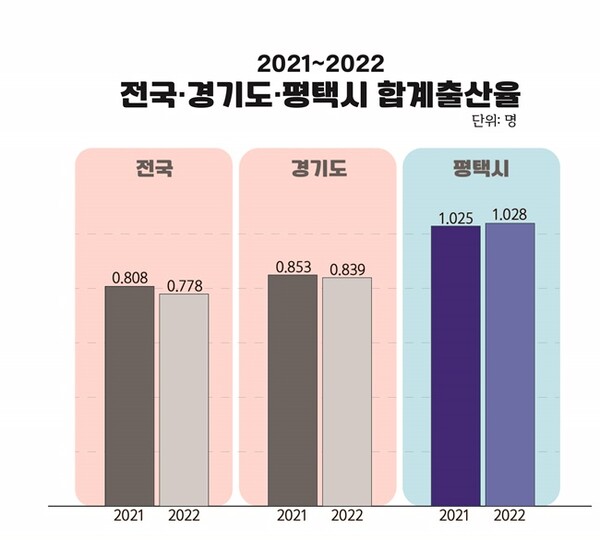
According to Pyeongtaek on the 19th, the 'Total Fertility Rate by Municipal Districts Nationwide in 2022' released by the National Statistics Portal on the 12th showed that the nation's total fertility rate decreased 3.7% from the previous year to 0.778 children.
Meanwhile, Gyeonggi Province's total fertility rate decreased 1.6% year-on-year to 0.839 children, while Pyeongtaek's total fertility rate increased 0.3% from the previous year to 1.028 children. This is 32% higher than the national average and 23% higher than the Gyeonggi Province average.
The total fertility rate refers to the average number of children a woman is expected to have during her reproductive years, ages 15 to 49, and is used as an indicator to measure a nation's or society's fertility rate.
To maintain the current population size, the total fertility rate must record 2.0 children or more. However, South Korea's total fertility rate fell below 2.0 starting in 1984 and has continued to decline since falling below 1.0 in 2018.
In this context, Pyeongtaek's 2022 total fertility rate maintained above 1.0 children and showed the characteristic of increasing compared to the previous year, contrary to the national trend.
Among municipal districts in the capital region including Seoul, Gyeonggi Province, and Incheon, 12 local governments recorded increased total fertility rates and 4 local governments had rates of 1.0 children or more. However, Pyeongtaek was the only municipality satisfying both conditions.
Notably, Pyeongtaek recorded a high birth rate despite being a major city. Nationwide, 47 local governments recorded total fertility rates of 1.0 children or more, but when looking only at municipalities with populations of 500,000 or more, only Pyeongtaek uniquely maintained a total fertility rate of 1.0 children or above.
A city official stated, "Young couples are moving into newly built apartments near Goduk International New City and Pyeongtaek Jigye Station, stable jobs are being created due to Samsung Electronics' Pyeongtaek Campus, and Pyeongtaek's social, environmental, and welfare policies working together in combination appear to have resulted in a relatively high birth rate."
Mayor Jeong Jang-seon said, "The fact that Pyeongtaek's birth rate has stopped declining and instead increased in a situation where birth rates are declining nationwide, and that the city uniquely maintains a total fertility rate of 1.0 or above among basic local governments with populations of 500,000 or more, is highly significant. Going forward, we will continue to improve Pyeongtaek's residential conditions so that many people can plan for second children and even consider multiple children, and we will create an environment where it is good to raise children."



Loading comments…