


Gyeonggi Province Expands Carbon Point Program...Increasing Incentives with Target of 70,000 New Households
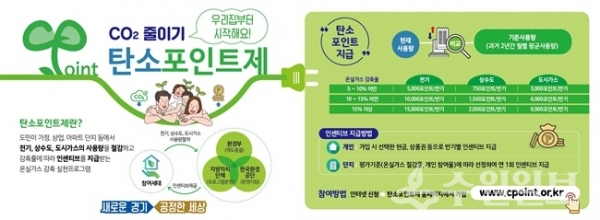
[Suwon Ilbo=Reporter Park No-hun] Gyeonggi Province is expanding and operating the 'Carbon Point Program,' part of its greenhouse gas reduction initiative in daily life aimed at achieving carbon neutrality by 2050.
The carbon point program, introduced by the Ministry of Environment in 2009, is a greenhouse gas reduction practice system that awards points based on energy consumption reduction results in households, commercial facilities, apartment complexes, and other locations.
Points received by participants can be exchanged for cash or items such as disposable trash bags (up to a maximum of 100,000 won per person per year).
Benefits are also available through NH Nonghyup Bank, including preferential interest rates of 0.1% and up to 70% discount on exchange fees.
Last year, 257,633 households and 1,207 complexes participated in Gyeonggi Province's program, reducing carbon dioxide by 50,199 tCO₂, with 104,608 households receiving 1.020 billion won in incentives.
The carbon point program has been implemented as a national treasury subsidy project funded by national and municipal/county budgets (50-50 ratio). However, this year the Province has separately allocated 700 million won as a provincial subsidy project (50% provincial, 50% municipal/county) to actively promote carbon neutrality practices.
Through this, the Province plans to expand new enrollment and increase incentive amounts (the scale of increase to be determined).
Targeting an addition of 70,000 new households, the Province will encourage enrollment by collaborating with all public officials and various public institutions and organizations within the province, while conducting customized promotions through various media including social media services (SNS) and various environmental education programs and events.
Enrollment can be done through direct registration on the Carbon Point Program website (cpoint.or.kr), or by inquiring at the relevant municipal, county, or district environmental department.
Choi Hye-min, Director of the Climate and Energy Policy Division, stated "For implementing carbon neutrality by 2050, greenhouse gas reduction activities in the daily lives of residents are more important than anything else," and added "We request the active participation and interest of residents."



Loading comments…