


Seven Cities in Southern Gyeonggi Province Join Hands for 'Integrated Development'
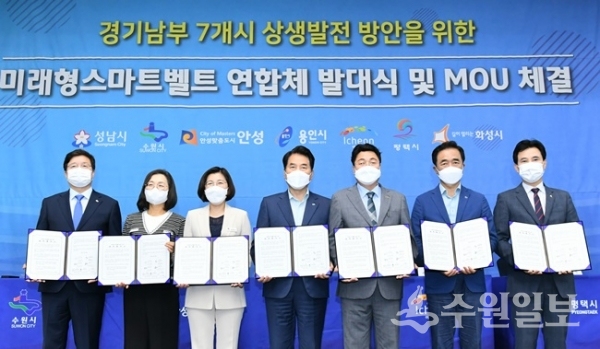
[Suwon Ilbo=Reporter Jung Jun-sung] Seven cities in southern Gyeonggi Province have formed a ‘Future-Type Smart Belt Alliance’ and joined hands for ‘integrated development.’
Suwon City and the cities of Seongnam, Anseong, Yongin, Icheon, Pyeongtaek, and Hwaseong signed the ‘Future-Type Smart Belt Win-Win Development Agreement’ on the 24th at the convention hall of Yongin City Hall and pledged cooperation.
Attending the signing ceremony were Yeum Tae-young, Mayor of Suwon; Eun Su-mi, Mayor of Seongnam; Kim Bo-ra, Mayor of Anseong; Baek Kun-ki, Mayor of Yongin; Eom Tae-jun, Mayor of Icheon; Jeong Jang-seon, Mayor of Pyeongtaek; and Seo Chul-mo, Mayor of Hwaseong.
The Future-Type Smart Belt Alliance is a ‘local government cooperation system’ that supports future industries such as semiconductors in line with the government’s ‘Fourth Capital Region Development Plan,’ which includes ‘Building a Smart Semiconductor Belt in Southern Gyeonggi Province,’ and President Moon Jae-in’s ‘K-Semiconductor Strategy’ announced in May, while actively requesting support from the central government.
The ‘K-Semiconductor Strategy’ is a strategy to establish the world’s most advanced semiconductor production base in Korea so that the nation can lead the global semiconductor supply chain by 2030, and includes plans to expand tax credits for semiconductor research and development, strengthen financial support, rationalize chemical substance regulations, and enact a ‘Semiconductor Special Act.’
Accordingly, the seven cities plan to set a common goal of ‘strengthening future industries and establishing future cities’ and cooperate closely.
The cities plan to formulate joint policies to support semiconductor companies in stable product production and create jobs linked to semiconductor-related industries. They also plan to review enacting joint ordinances to revitalize local businesses.
Additionally, the cities plan to actively introduce eco-friendly transportation (hydrogen and electric trams, etc.) and work together to improve air quality in the southern Gyeonggi region.
The local governments will serve as the main actors in expanding renewable energy supply and minimizing greenhouse gas emissions to create ‘carbon-neutral eco-friendly cities.’
Furthermore, the cities plan to establish a master plan together so that eco-friendly policies are reflected in each local government’s mid-to-long-term urban planning.
Loading comments…