


Gyeonggi Province Intensively Operates Seasonal Management Period to Improve High-Concentration Fine Dust in Rural Areas
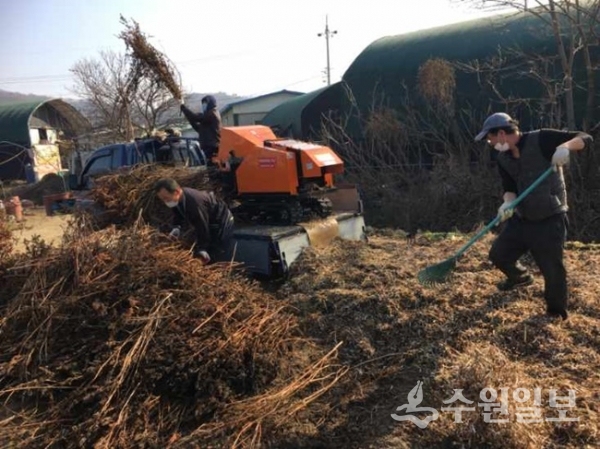
[Suwon Ilbo=Park No-hoon] Gyeonggi Province will support the operation of 'agricultural residue chippers' to reduce fine dust generation in rural areas by the end of March this year, during the special fine dust management period.
Agricultural residue chippers are machines that finely shred agricultural residues such as fruit tree branches, corn stalks, and barley straw.
The chippers can prevent fine dust generated by burning agricultural residues and can also produce natural compost from the shredded materials, creating a dual benefit effect.
According to the 'National Air Pollutant Emission Inventory (2017)' announced by the National Institute of Environmental Research, the amount of ultrafine dust (PM2.5) generated by burning agricultural residues in Gyeonggi Province is approximately 910 tons annually.
This is similar to the annual emissions from large buses (937 tons) and significantly exceeds the annual emissions from the manufacturing sector (761 tons).
While fine dust measures have so far focused on aging vehicle management and workplace supervision, this project represents a policy tailored to Gyeonggi Province's unique regional characteristics, which has many mixed urban-rural areas compared to Seoul and Incheon, and will be intensively promoted during periods of high fine dust concentration.
The support project will be funded with 1.143 billion won and will be concentrated first on 10 cities and counties, including Yangpyeong, Yangju, and Dongducheon, during the 'fine dust seasonal management period' (December 2020~March 2021).
The province plans to rent agricultural residue chippers and support 38 processing workers during this period.
Key support measures include ▲subsidizing rental fees for agricultural residue chippers ▲supporting operating expenses for chipper operations ▲supporting wages for chipping operation workers, etc.
Residents can rent chippers from agricultural machinery rental businesses at the village or crop group level and perform shredding operations, while for the elderly and women, specialized workers hired by cities and counties can perform the work on-site.
Kim Young-ho, Director of Agricultural Policy at Gyeonggi Province, said, "The agricultural residue chipper support project is expected to yield many benefits including reducing fine dust in rural areas, preventing forest fires, and securing high-quality compost, and we plan to conduct public awareness campaigns to promote open-air incineration bans at the eup and myeon levels as well."
Agricultural residue chipping support will be operated until the end of March this year, and farmers in cities and counties other than the 10 designated municipalities who wish to receive chipping support must apply during the needs survey by cities and counties by January 20th.
For more details, contact the environmental or agriculture departments of the relevant cities and counties.
Meanwhile, last year, the province supported 105 agricultural residue chippers and 70 workers across 21 cities and counties in Gyeonggi Province, processing 2,230 tons of agricultural residues including fruit tree pruning branches, corn, soybeans, and peppers.


Loading comments…