


Gyeonggi Province Institute of Health and Environment Announces Mask Performance Evaluation Results
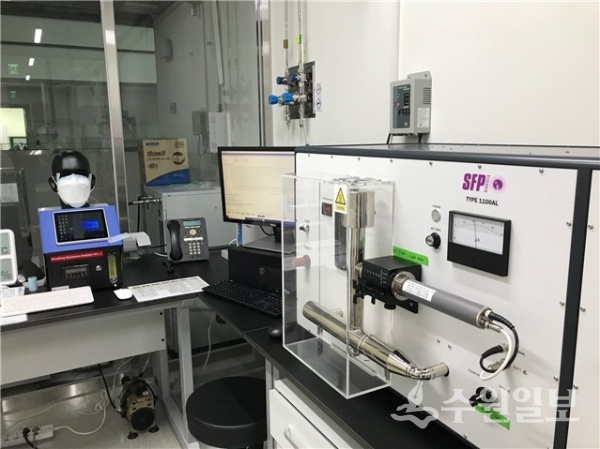
[Suwon Ilbo=Reporter Park No-hun] The Gyeonggi Province Institute of Health and Environment conducted a comprehensive performance evaluation of a total of 83 mask products currently distributed in the market through the internet and pharmacies, and announced the results on the 30th.
The evaluation focused on items applied to KF-grade health masks and covered a total of 8 items: dust collection efficiency (contamination blocking performance), facial intake resistance (breathing comfort), purity test (acids and alkalis, dyes, formaldehyde, and optical brighteners), strap junction tensile strength, and liquid resistance.
According to the evaluation results, the dust collection efficiency was highest in KF94-grade products at 99% for sodium chloride (99% for paraffin oil). KF80-grade products showed 89% for sodium chloride (74% for paraffin oil), while droplet-blocking masks and surgical masks followed at approximately 67-74% for sodium chloride (approximately 67-70% for paraffin oil).
Among general masks, disposable non-woven masks showed a blocking performance of 64% for sodium chloride (57% for paraffin oil). Cotton masks showed 38% for sodium chloride (21% for paraffin oil), polyurethane masks, commonly known as celebrity masks, showed only 13% for sodium chloride (4% for paraffin oil), and mesh masks showed 17% for sodium chloride (6% for paraffin oil).
Dust collection efficiency is measured by creating dust in an experimental environment, passing it through the mask filter, and then measuring the dust that passes through. Depending on the substance serving as dust, sodium chloride (aerosol particles) and paraffin oil (mist particles) are measured.
Facial intake resistance was highest in KF94 products, followed by KF80, droplet-blocking and surgical masks, and then general masks. It was found that the higher the contamination blocking performance, the greater the resistance value on the face, making breathing more difficult.
Medical device masks (KF94, KF80, droplet-blocking masks, and surgical masks) had no non-compliant products in quality inspections including purity tests to investigate the presence of harmful substances, strap junction tensile strength tests, and liquid resistance tests.
The Gyeonggi Institute of Health and Environment said that general masks have diverse types and purposes compared to medical devices, and since there are no specification standards for contamination blocking performance, special care is needed in their use. Among general masks, products with non-woven filters showed contamination blocking performance similar to droplet-blocking and surgical masks, but the remaining products showed very low blocking performance.
Oh Jo-gyo, director of the Gyeonggi Province Institute of Health and Environment, said, "We conducted this evaluation to provide scientific evidence on mask use while COVID-19 persists, contributing to protecting the health of citizens," and "We will continue to conduct regular inspections to ensure the safety of masks distributed in the market."



Loading comments…