


90% of Gyeonggi Province Enterprises Say They'll Use Gyeonggi Province's Fair Procurement System
[Suwon Ilbo=Park No-hun Reporter] As Gyeonggi Province pursues development of its own procurement system to replace the government's National Procurement Service, a survey has shown that 9 out of 10 companies in Gyeonggi Province expressed a positive stance on the initiative.
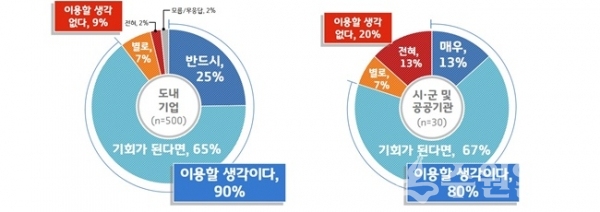
Gyeonggi Province announced on the 9th that a survey was conducted from July 2 to 15 on "public procurement system usage and perception" targeting 500 companies and 30 public institutions, including 250 companies registered in the National Procurement Service's Integrated Shopping Mall and 250 non-registered companies. The results showed that 90% of companies and 80% of public institutions answered they "would be willing to use" the system if Gyeonggi Province develops its own fair procurement system.
Regarding the prices of goods sold on the National Procurement Service's Integrated Shopping Mall, 70% of purchaser public institutions answered that "unit prices are higher compared to other online shopping malls," and 40% of seller-registered companies also said unit prices were high.
In a survey of detailed opinions on the fair procurement system being pursued by Gyeonggi Province, 79% of companies and 80% of public institutions agreed on the necessity of applying market unit prices to procurement market goods.
For the procurement system that monitors bidding collusion and other unfair practices using big data to identify illegal activities in advance, 85% of companies and 90% of public institutions said it is necessary. On the method of using revenue generated from public procurement, such as procurement fees, for regional governments or small and medium enterprises, 80% of both companies and public institutions answered it is "necessary."
Meanwhile, when asked whether they have experienced or suspected bidding collusion during National Procurement Service bidding, about 1 out of 6 companies, or 17%, answered "yes," and 13% of public institutions answered "yes." However, among those with experience or suspicion of bidding collusion, the majority was confirmed to have "taken no particular action" (94% of companies, 100% of public institutions).
Kim Ki-se, director of the Local Government Administration Bureau, said "Through this survey, we were able to confirm that both companies and public institutions are aware of the seriousness of issues caused by monopoly of the procurement system," and added "Gyeonggi Province will promptly pursue development of the Gyeonggi Province Fair Procurement System to resolve the problems caused by procurement monopoly and establish a procurement system that serves the public through fair competition between procurement systems."
The survey was commissioned by Gyeonggi Province to Korea Research, a polling agency, and was conducted using a mixed survey method including in-person visits, telephone, email, and fax surveys. With a 95% confidence level, the sampling error is ±4.4%p for companies and ±13.1%p for public institutions.


Loading comments…