


Gyeonggi Province Operates '24-Hour Mental Health Emergency Center with Screening Testing Center'
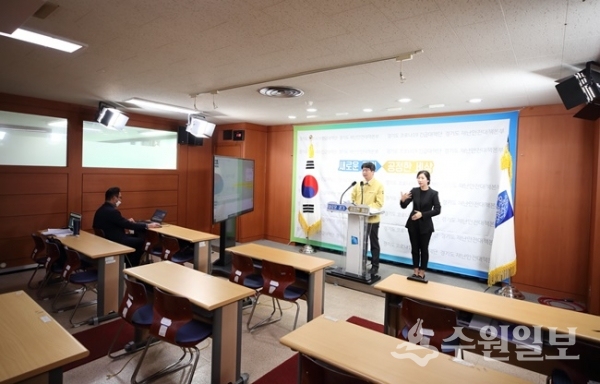
[Suwon Ilbo=Reporter Park No-hoon] Gyeonggi Province is operating a '24-hour mental health emergency center and screening testing center' for patients with mental illness.
Lim Seung-gwan, co-head of Gyeonggi Province's COVID-19 Emergency Task Force (director of Gyeonggi Provincial Medical Center Anseong Hospital), said at a regular briefing on the 23rd, "As COVID-19 spreads, concerns about insufficient hospital beds and in-hospital infections are causing psychiatric medical institutions to avoid new patients, raising concerns about treatment gaps for those with mental illness." He added, "Since it is difficult to understand the movement and epidemiological patterns of patients with mental illness through interviews, it is necessary to establish a screening center for them."
Accordingly, Gyeonggi Province plans to utilize the negative pressure ward at the Gyeonggi Provincial Medical Center Suwon Hospital and dispatch 20 staff members, including doctors and nurses from Gyeonggi Provincial Mental Hospital, to operate a COVID-19 screening center for psychiatric emergency patients.
Lim said, "This measure is expected to prevent infectious diseases from entering psychiatric medical institutions and enable the mental health emergency patient transfer system in the province to function properly." He added, "By allocating some public medical resources to psychosocial disadvantaged groups so they can receive appropriate testing and treatment, it also has a socially integrative significance."
Meanwhile, Lim announced that as of midnight on the 23rd, 354 confirmed COVID-19 cases have been reported in Gyeonggi Province (8,961 nationwide). This represents an increase of 17 cases compared to midnight the previous day. The number of confirmed cases per million population is 25.7, ranking 9th among the 17 cities and provinces nationwide.
By city and county, confirmed cases occurred in 25 municipalities in Gyeonggi Province, with Seongnam having 100 cases, Bucheon 51 cases, and Yongin 34 cases in that order. The number of confirmed cases per 100,000 people is highest in Seongnam with 10.41 cases, followed by Gwacheon with 8.55 cases and Bucheon with 5.97 cases. Of the confirmed cases in Gyeonggi Province, 89 have been discharged and 262 are currently in isolation.
Regarding the Central Disaster Management Headquarters implementing COVID-19 diagnostic testing on all entry-level individuals from Europe starting at midnight on the 22nd, Gyeonggi Province has supported three mobile screening containers to Incheon Airport Quarantine Office [1 at Terminal 1, 2 at Terminal 2] on the 22nd at the urgent request of the quarantine office, to be used as diagnostic testing sites for overseas arrivals.
In the province, 24 overseas-imported confirmed cases have occurred over the past week, of which 79%, or 19 cases, are from Europe. At Gunpo Hyo-sarang Nursing Home, where a cluster infection occurred, the first patient among residents was confirmed on the 19th. To date, there are 7 confirmed cases and 61 contacts. The first confirmed case died on the 22nd.
The province dispatched an immediate response team to identify contacts through in-depth epidemiological investigation and secured a list. Environmental disinfection was carried out in the facility and along the movement routes of confirmed cases.
Floor 5 of the nursing home where confirmed cases occurred has been under internal cohort isolation since the 19th, and Floor 4 since the 21st. A full-scale test is being conducted on 56 people including staff and residents of the nursing home, and 16 staff members are under self-quarantine.
Regarding Gyeonggi Province's hospital bed operations, as of midnight on the 23rd, a total of 443 beds are secured at 14 hospitals through cooperation with 3 nationally designated hospitalization treatment facilities, 6 Gyeonggi Province public medical institutions, 1 Seongnam Medical Center, and 4 private tertiary general hospitals in the province. Currently, 295 beds (66.6%) are in use.
Lim also explained that while the government decided to implement high-intensity physical distancing (social distancing) for 15 days from the 22nd to April 5th, Gyeonggi Province has already proactively implemented physical distancing.
The province is intensively promoting physical distancing on city and county homepages, YouTube, and social media (SNS), and is producing and distributing physical distancing posters to multi-use facilities such as PC rooms and karaoke establishments.
Additionally, starting from the 18th, the province has guided multi-use facilities such as singing practice rooms, PC rooms, clubs and karaoke establishments in Gyeonggi Province on compliance with infection prevention rules, and plans to continue monitoring compliance until April 6, when elementary, middle, and high schools reopen.
In addition, Lim introduced that the Gyeonggi Province COVID-19 Emergency Task Force will regularly hold web seminars (webinars) to help exchange accurate medical information and develop proper medical policies.
Through public-private cooperation, Gyeonggi Province is organizing and operating not only the Emergency Task Force but also an Expert Advisory Committee. Professor Kim Hong-bin from the Department of Infectious Diseases at Seoul National University Bundang Hospital and Professor Jeong Hae-gwan from the Department of Social Medicine at Sungkyunkwan University School of Medicine serve as co-chairs of the advisory committee, and a total of 22 experts, including clinical and basic scientists as well as health center directors and infection control nurses, hold regular meetings once a week to assist Gyeonggi Province in producing response policies.
Gyeonggi Province plans to expand this meeting and hold web seminars every Thursday starting the 26th. The web seminars are intended for doctors working in various medical institutions in Gyeonggi Province as the main audience, but are also planned to be open to others with interest.
Lim said, "To properly respond to the outbreak of novel infectious diseases, accumulated information must be analyzed to quickly and accurately create grounds that can be reflected in policies." He added, "Sharing data accumulated by Gyeonggi Province will be of significant help to the central government and other local governments."


Loading comments…