


Gyeonggi Province Youth Basic Income: 8 Out of 10 Young Users 'Satisfied'
[Suwon Ilbo=Reporter Park No-hun] A satisfaction survey conducted on 3,500 young people who applied for Gyeonggi Province's Youth Basic Income and received and used regional currency showed that satisfaction increased by 2.1 percentage points in the third quarter compared to the first quarter. Additionally, Gyeonggi regional currency demonstrated positive results in halting sales declines among small business owners.
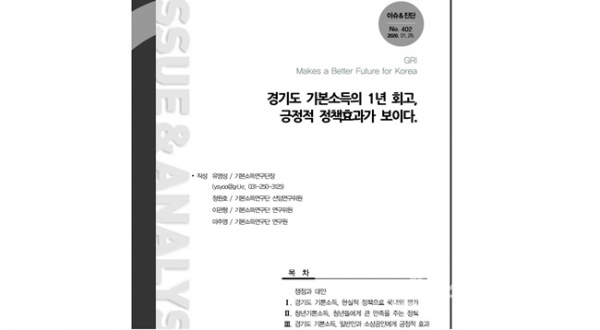
According to the Gyeonggi Research Institute on the 2nd, following the first Youth Basic Income satisfaction survey in Gyeonggi Province (July 2019), a second survey (November 2019) was conducted targeting young people who received and used regional currency in all three periods (1st, 2nd, and 3rd). The results were included in a report titled "One Year in Retrospect of Gyeonggi Province's Basic Income: Positive Policy Effects Emerging."
Survey results showed that for overall satisfaction, "satisfied" responses increased by 2.1 percentage points to 82.7%, compared to 80.6% in the first survey. The main reasons for youth satisfaction were analyzed as meeting the basic income's constituent elements: universality, cash provision, and conditionality.
The provision of youth basic income brought positive changes to young people's lives, with 65.4% responding that "there were beneficial changes in my life." This represents a 5.1 percentage point increase from the first survey result of 60.3%. The primary reasons cited for life changes in both the first and third quarters were reduced financial worries when socializing with friends and the ability to pursue self-development.
Encouraging results also emerged from pre/post panel surveys conducted with a comparison group of young people aged 24 from regions outside Gyeonggi Province. Young people in Gyeonggi Province showed more positive and improved results in various categories—including happiness, health and diet, awareness and attitudes, dreams and capital, and economic activity—compared to both pre-survey results and the comparison group. As a result, the "degree of happiness" among Gyeonggi Province youth was measured at 63.5 points, higher than the comparison group's 59.0 points.
Qualitative survey results (FGI; Focused Group Interview) from 33 youth recipients of Gyeonggi Province's youth basic income also showed mostly positive reactions, including comments such as "my life satisfaction improved because I could do something for others" and "it was a ray of hope."
Results from a public deliberation survey targeting Gyeonggi Province residents showed that as discussion and deeper understanding of basic income accompanied greater engagement, positive perceptions of basic income strengthened, leading to a shift where people agreed to tax increases for basic income (32%→75%).
The provision of Gyeonggi regional currency was analyzed as contributing to halting the downward trend in sales of small business owners in Gyeonggi Province.
A survey of 3,212 small business establishments across 31 cities and counties in Gyeonggi Province was divided into a pre-survey (March-April 2019) and post-survey (July-August 2019), based on April 1, 2019, when the issuance of Gyeonggi regional currency began in earnest.
Survey results showed a consensus that the economy was declining with decreased sales. The average monthly sales per establishment among all small business respondents in the first quarter of 2019 was 19,136,737 won, whereas the average monthly sales in the second quarter of 2019 was 18,655,384 won, a decrease of 481,353 won (2.5% compared to first quarter sales). The average monthly sales from Gyeonggi regional currency in the second quarter of 2019 was 388,728 won per establishment, equivalent to 2.1% of the average total monthly sales in 2019 (18,655,384 won).
If sales from Gyeonggi regional currency had not occurred, small business owners' average monthly sales in the second quarter of 2019 would have decreased by 4.55 percentage points compared to the first quarter, rather than 2.5 percentage points. This suggests that Gyeonggi regional currency had a positive impact on maintaining sales of small business owners in Gyeonggi Province to some extent.
Yu Young-sung, head of the Basic Income Research Division at the Gyeonggi Research Institute, said, "While Gyeonggi Province's basic income policy is in its early stages, satisfaction is very high and positive policy effects are being demonstrated, so policy stabilization and long-term foundation building are necessary."
Despite high satisfaction with youth basic income, selective welfare concepts remain prevalent. This underscores the importance of strengthening public relations regarding the significance of universal welfare such as basic income.
Director Yu stated, "In the long term, we must focus on laying the groundwork for expanding basic income policy nationwide," and cited examples including "▲adjusting expenditure budgets within Gyeonggi Province ▲expanding basic income funding sources beyond budgets ▲preparing basic income legislation for nationwide implementation." He added, "It is also necessary to establish plans for revamping the national tax system, budget and fiscal structures, such as introducing a land value tax."

Loading comments…