


Pyeongtaek City Holds 5th Citizen Collaboration Academy
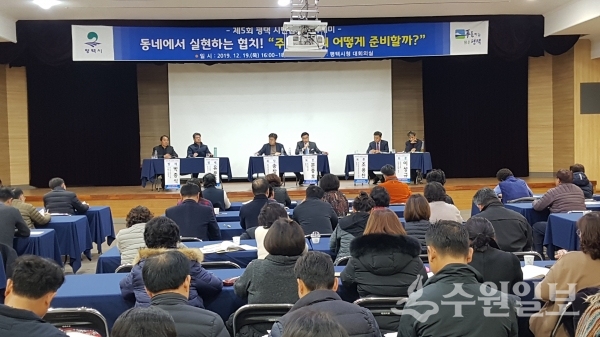
[Suwon Ilbo=Reporter Seo Dong-young] On the 19th, Pyeongtaek City held the '5th Pyeongtaek Citizen Collaboration Academy' with about 100 participants including citizens, resident autonomy committee members, and civil servants under the theme 'Governance Realized in Our Neighborhood: How to Prepare for Resident Autonomy Councils?'
Ahead of the pilot implementation of resident autonomy councils next year, the academy examined issues at each stage of progress for the transition to resident autonomy councils, and discussed the sharing of cases from other regions and support and institutional measures necessary for the successful establishment of the first implementation.
The academy featured presentations by ▲Yu Mun-jong, director of the Suwon 2049 Civic Research Institute ('Understanding Resident Autonomy Councils: The Era of Neighborhoods, Citizens, and Resident Autonomy') and ▲Park Jong-sik, chairman of the Daya-dong Resident Autonomy Council in Siheung City ('Daya-dong: A Large Neighborhood Below Sorae Mountain'). The discussion panel included Moon Jong-ho, head of the Civic Cooperation Division of Pyeongtaek City; Cho Yong-chan, chairman of the Pyeongtaek City Resident Autonomy Committee Council; and Lee Sang-gyu, chief of Sinpyeong-dong 25 unit (Yucheon 3-dong), designated as discussants who engaged in focused discussions on issues and challenges regarding the transition to resident autonomy councils.
Director Yu Mun-jong stated, "Resident autonomy councils can have a very diverse implementation process depending on local circumstances. In particular, since conflicts may arise within the region, there must be sufficient discussion and consensus-building among residents. Through this process, bottom-up decision-making can be achieved, enabling the implementation of resident-centered operational principles."
Meanwhile, ahead of this year's pilot implementation of resident autonomy councils, the city has established the foundation for the transition by ▲holding education and briefing sessions for residents ▲enacting the 'Pyeongtaek City Ordinance on the Pilot Implementation and Establishment and Operation of Resident Autonomy Councils' ▲operating resident autonomy education programs (November 26 – December 8). In 2020, the city plans to conduct the first pilot implementation of resident autonomy councils in four administrative districts within the city (Jinwi-myeon, Oseong-myeon, Songbuk-dong, and Bijeong 2-dong).
Resident autonomy councils serve as resident representative bodies that gather diverse thoughts and demands from residents to discuss and decide together with residents. They establish autonomy plans reflecting various local issues and, through resident general assemblies, determine local agendas that residents can feel and play a role in resolving community problems.

Loading comments…