


Pyeongtaek City Showing Results in Fine Dust Reduction Efforts
[Suwon Ilbo=Seo Dong-young Reporter] Pyeongtaek City announced on the 14th that results are emerging throughout the city from its efforts to reduce fine dust.
To solve the fine dust problem, the city established the "Blue Sky Project," a comprehensive fine dust reduction plan, starting in July last year. The city is working to address both internal and external fine dust issues.
Through government recommendations and joint responses with neighboring local governments, Pyeongtaek has actively responded to fine dust problems generated from major government infrastructure facilities including Pyeongtaek Port, Hyundai Steel, and the Western Thermal Power Plant.
According to an announcement by the Ministry of Oceans and Fisheries on December 5, six shore power supply facilities (AMP) will be installed at Pyeongtaek Port by next year. A total of 24 additional AMP units are scheduled to be added by 2030.
Shore power supply facilities (AMP) are systems that provide necessary electricity to moored vessels from land at ports. When large ships are berthed, they use bunker C oil and diesel to operate the ship's systems, which generates significant amounts of fine dust. The AMP system fundamentally blocks fine dust generated during berthing by using shore-based power to operate the ship's systems instead.
Once a total of 24 AMP units are installed as planned by the Ministry of Oceans and Fisheries, the fine dust generated from ships berthed in Pyeongtaek Port is estimated to reduce 417 tons, equivalent to 38.9% of the total emissions (based on PM2.5) of 1,071 tons according to 2016 National Institute of Environmental Research atmospheric pollutant emission data.
The city has consistently recommended AMP installation at Pyeongtaek Port since 2017 to solve the fine dust problem. In March, Mayor Jeong strongly recommended AMP installation during a meeting with the Prime Minister, and continued to recommend AMP installation during two meetings with the Minister of Environment in April and a meeting with the Minister of Oceans and Fisheries in May.
At the same time, efforts to reduce fine dust through coordination with Hyundai Steel and Pyeongtaek Thermal Power Plant, government infrastructure facilities, are also showing results.
The city established a public-private-industry consultation body composed of the city, environmental organizations, and Hyundai Steel to share information and maintain regular communication for pollution reduction. Hyundai Steel has partially improved its sintering furnace process. From June next year, when all sintering furnaces are improved and completed, fine dust emissions are expected to be reduced by more than 50% compared to previous levels.
Korea Western Power's Pyeongtaek Power Headquarters, which signed an agreement with the city in November, plans to convert four heavy oil power generators to clean fuel LNG starting February 2020. Upon completion of the conversion, approximately 121 tons of fine dust, equivalent to 84% of 143 tons of atmospheric pollutants generated based on 2018 standards, is expected to be reduced.
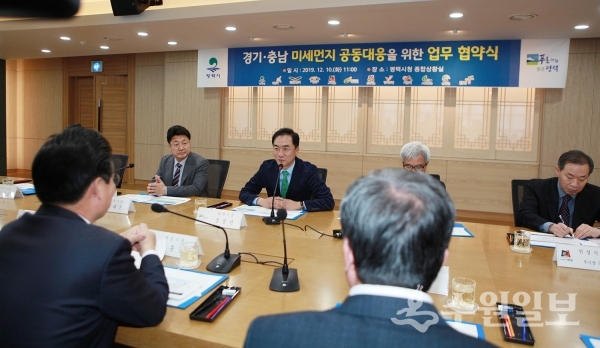
A broader joint response system transcending administrative boundaries has also been established. On December 10, under the city's leadership, 12 local governments in southern Gyeonggi Province and the Yellow Sea region of South Chungcheong Province formed a joint response consultation body for fine dust. The consultation body began with a proposal by Mayor Jeong Jang-seon in February, when six cities in southern Gyeonggi Province signed an agreement in September. This time, it has developed into a consultation body of 12 local governments including South Chungcheong Province.
Mayor Jeong said, "The fine dust problem is not only a regional issue but also intertwined with surrounding government infrastructure facilities, making it difficult to resolve in the short term," while adding, "Since it is directly related to citizens' health, we will mobilize all possible efforts."

Loading comments…