


Yongin Mayor Baek Gun-gi Pulls Out All Stops to Secure National Funding for Core Projects
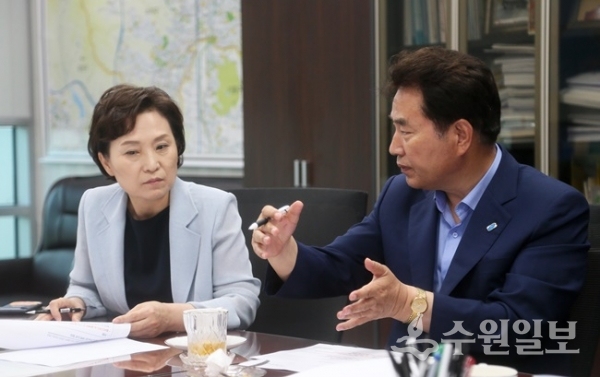
[Suwon Ilbo=Reporter Park No-hun] Yongin Mayor Baek Gun-gi has taken direct action to successfully push forward core projects.
According to Yongin City on the 28th, Mayor Baek is making an all-out effort to secure national funding by requesting government and ruling party support for road network construction and infrastructure installation to smoothly advance core projects such as the semiconductor cluster and Platform City.
In this regard, Mayor Baek recently met with Minister of Land, Infrastructure and Transport Kim Hyun-mi at the National Assembly Members' Building to request that six road networks necessary for the semiconductor cluster and Platform City, which is included in the Third New City project, as well as railroad networks such as the extension of the Suseo-Gwangju double-track railway, be reflected in the five-year national and local road plan and the national railroad network construction plan.
The targeted road network projects are ▲expansion and improvement of Local Road No. 57 (Maping-Godang) ▲extension of alternate bypass road on National Road 42 ▲establishment of new auxiliary metropolitan road for Yongseong Expressway ▲underground installation of Local Road No. 23 Bora-Bojeong section ▲promotion of Local Road No. 57 (Pogok-Maping) to national road alternate bypass status ▲underground installation of National Road 43 Sanghyun-Jukjeon section.
Mayor Baek also specifically requested active national funding support for infrastructure to enable the semiconductor cluster, a national project, to be developed smoothly and without delay.
The city plans to apply for national funding in early next year for 50% of the cost of installing industrial water supply facilities and wastewater treatment facilities at the general industrial complex of the semiconductor cluster to be developed across 4.5 square kilometers in the Wonsam-myeon and Dokseong-Jukneung-ri areas of Cheoin-gu, as well as for new access road construction costs.
Article 29 and others of the current Industrial Sites and Development Act stipulate that industrial complex infrastructure such as roads, railways, and water supply facilities can be supported with national funding through deliberation by the Ministry of Land, Infrastructure and Transport's industrial location policy.
Mayor Baek is also continuously requesting cooperation from the ruling party to secure national funding. On the 27th, he attended a budget policy consultation meeting of the Democratic Party's Gyeonggi Province branch basic local governments held at the National Assembly Main Building, explaining pending issues including the construction of core road networks related to the semiconductor cluster and the park development of Giheung Lake, a presidential campaign pledge, and requested support.
The fact that Mayor Baek has personally come forward to receive government support related to the city's core projects reflects that while each project is urgent, the city's fiscal conditions are not favorable due to economic slowdown in Gyeonggi Province.
Mayor Baek said, "Next year's tax revenues are expected to decrease due to the aftermath of trade wars between Korea and Japan and between the U.S. and China, so we reduced unnecessary projects when compiling the budget," and added, "Nevertheless, since projects that are nationally necessary must be pursued, we are making all-out efforts to secure national funding."

Loading comments…