


Gwanggyo New City Land Development Plan Finalized
Gyeonggi Province announced on the 2nd that the Gwanggyo New City land development plan for approximately 3.41 million pyeong (11.3 million square meters) in the Iui-dong area of Suwon City has received final approval from the Ministry of Construction and Transportation, and the province will proceed with full-scale development.
Gwanggyo New City will be constructed in a self-sufficient administrative complex city format with a capacity of 60,000 residents across approximately 3.41 million pyeong spanning Iui, Woncheon, and Uman districts in Suwon City, Sanghyeon-dong in Yongin City, and Yeongdeok-ri in Giheung-eup, and is scheduled for completion by December 2010.
Major facilities include a metropolitan administrative business district (54,000 pyeong), a metropolitan commercial recreation zone including Woncheon Park (900,000 pyeong), and an advanced R&D; complex (192,000 pyeong). Housing will consist of a total of 24,000 units, including 21,987 apartments and 2,013 detached houses.
Of the apartments, 42% (9,300 units) will be mid-to-large sized units, and 31% (6,700 units) will be rental housing. The green space ratio will be 45.5%, and the population density per hectare will be 53 people, providing far more pleasant living conditions compared to Pangyo (35%, 98 people per hectare) or Bundang (20%, 198 people per hectare).
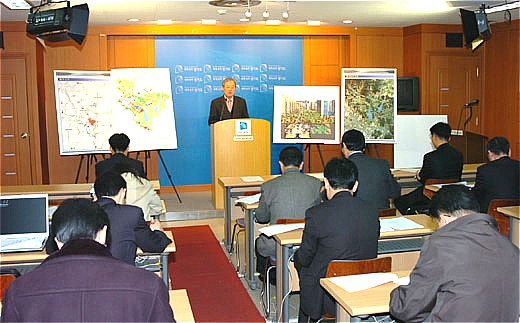 | ||
| ▲ Kim Seok-woo, head of the New City Development Support Team, briefs the media at the Gyeonggi Province Government briefing room on the 2nd regarding the approval of the Gwanggyo New City land development plan. | ||
The administrative district will be home to regional administrative agencies including the provincial government, provincial assembly, Suwon District Prosecutors' Office, and Suwon District Court. The advanced R&D; center will house the Gyeonggi Bio Center, biomedical organ production research facility, next-generation convergence technology research institute, R&D; business building, and nano-device specialized fab center by the end of next year.
To address traffic demand in the new city, the province plans to attract as many regional administrative agencies and advanced industries as possible to suppress commuter traffic to Seoul, and will resolve traffic congestion through extension of the Shinbundang Line, establishment of transit centers, and expansion of connecting roads.
Specifically, the province will construct five metropolitan roads: North Suwon-Sanghyeon IC (4 lanes, 7.9 km), Sanghyeon IC-Hadong (6 lanes, 2.5 km), Heungdeok-Hadong (6 lanes, 2.1 km), East Suwon-Seongbok IC (4 lanes, 3.3 km), and Yongin-Seoul Expressway (6 lanes, 2.3 km). It will also implement grade separation at four intersections: Sanghyeon IC, Hadong, Dongmun, and East Suwon IC, and will install a BRT (Bus Rapid Transit) system on the Gwanggyo-East Suwon intersection (3.4 km) section.
Additionally, the Ministry of Construction and Transportation plans to construct a double-track railway extension of the Shinbundang Line to the new city.
The new city will incorporate ubiquitous technology concepts, and existing waterfront spaces including Woncheon Park and Sindae Reservoir will be preserved in park form.
The province plans to complete land appraisal and compensation negotiations in the first half of this year, proceed with real estate plan approvals by year-end, and begin housing sales starting next year.
Upon completion of the project, the province expects to generate 19 trillion won in production ripple effects and create 170,000 jobs.


Loading comments…