


What Does It Take to Succeed in Elderly Care Guarantee System Pilot Program?
On the 22nd, Rep. Kim Jin-pyo and Rep. Lee Ki-woo of the Democratic Open Party held forums to explore alternatives to the low birth rate and aging population issues that have emerged as a core challenge for our future society, separately at the National Assembly and in Suwon.
At the forum, Rep. Kim Jin-pyo, who chairs the National Assembly's Research Institute on Public Finance and Taxation, sought policy direction on "fiscal policy direction in an era of low birth rates and aging" by leveraging the characteristics of his institute, while Rep. Lee Ki-woo explored operational measures for the elderly care guarantee system that has emerged with the arrival of an aging society.
In particular, Rep. Lee Ki-woo's forum coincided with Suwon being selected as a pilot project region for the elderly care guarantee system promoted by the government, and served as an occasion to explore the direction of Korea's elderly care guarantee system. This article provides on-site coverage of the policy forums consecutively held by the two representatives at the National Assembly and in the region.<Editor's Note>
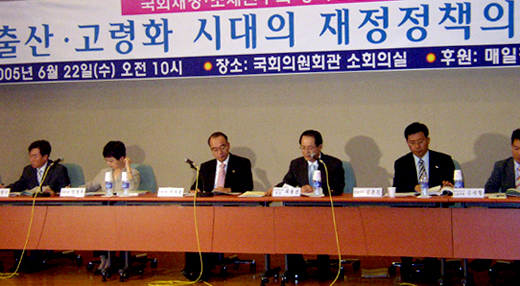 | ||
| ▲ Policy forum on elderly care for Reps. Kim Jin-pyo and Lee Ki-woo of the Democratic Open Party | ||
▲Need for Efficient Management of National Finances in Aging Society
Choi Yong-seon, president of the Korea Institute of Public Finance, stated, "As public expenditures related to the elderly increase, overall public expenditures are expected to increase significantly," and predicted that "the fiscal burden from aging will become heavier over time and will pose a major burden starting from 2020."
President Choi pointed out that "despite such long-term serious impacts of aging, it is dangerous to view responses to aging as elderly welfare policies alone at this point in time."
President Choi also said, "When implementing comprehensive welfare systems applicable to the current young generation, who can predict the progress of aging, the long-term fiscal burden on the state will inevitably increase," emphasizing that "it is necessary to manage government debt so that it does not reach excessive levels."
As a way to reduce the state's fiscal burden, President Choi added, "It is necessary to establish a strategy to prevent the proportion of public expenditure from becoming too high through cutbacks in fiscal expenditures in other sectors and effective control of additional fiscal expenditure programs."
President Choi further diagnosed that "expenditure increases due to aging are inevitable permanent changes" and pointed out that "as the burden of taxes or social insurance premiums increases, distortions in the economy and negative impacts on growth may emerge."
President Choi's such observations were his own diagnosis on how to efficiently manage national finances in a situation where public expenditures due to an aging society are bound to increase.
As a way to efficiently operate national finances while establishing a social welfare system for an aging society, President Choi emphasized the necessity of providing childcare support to increase birth rates.
President Choi stated, "Given the characteristics of Korea's personal income tax system, it is difficult to expect that expanding income tax deductions will have an effect in increasing birth rates," and pointed out that "childcare support and easing of educational expenses for children are necessary."
In particular, President Choi emphasized, "It is problematic for policies addressing aging to be understood as policies expanding elderly welfare," stressing that "long-term policy responses are necessary."
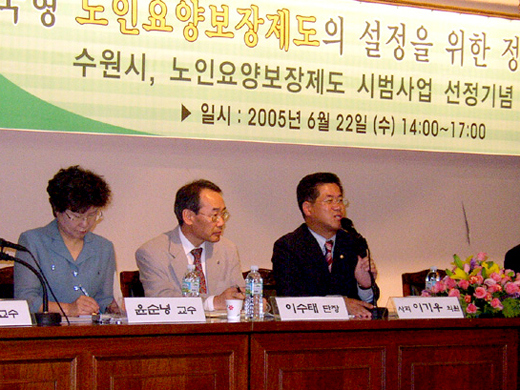 | ||
| ▲ Policy forum on elderly care for Reps. Kim Jin-pyo and Lee Ki-woo of the Democratic Open Party | ||
▲ Introduction of Long-Term Care Insurance is an Essential Policy Choice
The "Policy Forum for Setting Up Korea's Elderly Care Guarantee System" held in Suwon on the 22nd was an occasion to explore operational directions for the newly introduced elderly care guarantee system, which is a social security system.
The elderly care guarantee system has continuously raised the necessity of introducing a public elderly care guarantee framework at the national level as the number of elderly people requiring long-term care services due to rapid aging, such as dementia and stroke, has increased. While the existing health insurance provides treatment-oriented services for illness and injury through hospitals and pharmacies, the elderly care guarantee system provides services such as nursing care and attendant services for elderly patients with dementia and stroke through care facilities and home-based service agencies. At the policy forum, Professor Kim Jin-soo of the Department of Social Welfare at Yonsei University emphasized, "Regarding the introduction of long-term care insurance, the most important task at the initial stage is the expansion of facility and personnel infrastructure," and stressed that "policy weight on this matter should be increased."
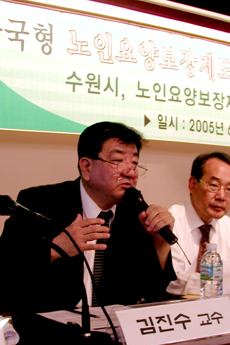 | ||
| ▲ Policy forum on elderly care for Reps. Kim Jin-pyo and Lee Ki-woo of the Democratic Open Party. Professor Kim Jin-gyu. | ||
In particular, Professor Kim stated, "Two concerns may be raised regarding infrastructure construction and facility expansion," adding that "they are the possibility of securing finances and measures to resolve regional imbalances due to differences in local government fiscal capacity."
There were also calls regarding Suwon City, which was selected as a pilot project region. Professor Kim emphasized, "Considering that the facility securing plan currently presented by the central government is at a minimum level, Suwon City should add efforts to establish an exemplary elderly care service system through independent budget securing, advancement of residential facilities, and ensuring quality in home-based services."
Professor Kim added, "The introduction of long-term care insurance is an essential policy choice in light of the rapid increase in demand for elderly care," and emphasized that "harmony among central, local, and private sectors should be achieved so that maximum functions and roles can be performed."
<Yeouido Communications=Reporter Kim Dong-hyun>
Loading comments…