


| 'Opening the Dawn Lecture' is a column that live-broadcasts breakfast lectures by the Korea Human Development Institute (KHDI), under the slogan "Good people create a good world." KHDI has held breakfast lectures every Thursday at 7 a.m. for the past 30 years without missing a single session, recording 1,403 lectures (as of this week) and earning recognition as the country's most frequently held and most authoritative lecture series. This article summarizes remarks delivered by Vice Minister of Labor Jung Byung-seok on May 26 at the Emerald Room on the second floor of Lotte Hotel Seoul, with the theme 'Current State and Challenges of Labor-Management Relations This Year,' and we hope it will be of some benefit to our local residents in broadening their knowledge. (Editor's note) |
Vice Minister of Labor Jung Byung-seok is known as a labor administration expert combining both theory and practice. After passing the civil service exam in 1978, he began his bureaucratic career at the Ministry of Labor and has dedicated 27 years to one field. The numerous positions he has held—from Chief of Employment Measures Division to Chief of Employment Policy Division, Chief of Working Standards Division, Director of the Gwangju Regional Labor Office, Senior Auditor for Overall Employment, Director of Working Standards Bureau, Director of Labor-Government Relations Bureau, Director of Planning and Management Office, and finally Vice Minister—serve as medals testifying to his extensive experience in the Ministry of Labor. Yet even for him, recent labor-management issues present a perplexing subject of study.
"In our work, we must meet simultaneously with management and workers, and each time, both sides run parallel courses and show contradictory responses. First, management and employers criticize that while Korean labor unions are excessively militant and combative, the current labor law is overly pro-worker. Meanwhile, labor unions and the International Labor Organization (ILO) criticize that Korea is among the world's worst in suppressing labor movements and that the current labor law still restricts workers' rights by international standards. Recently, our government had to go to the OECD and painstakingly persuade them that Korea is not a labor movement suppression country."
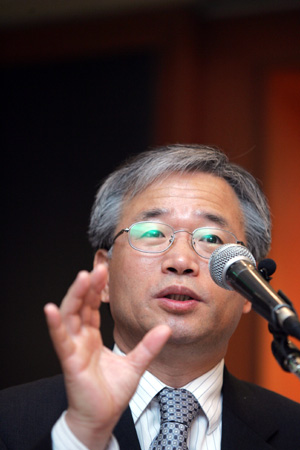 | ||
| ▲ On the 26th, a breakfast lecture hosted by the Korea Human Development Institute was held at the Emerald Room of Lotte Hotel in Sogong-dong. Vice Minister of Labor Jung Byung-seok delivered a lecture on the theme 'Current State and Challenges of Labor-Management Relations This Year.' /Yeouido Communications, Kim Jin-seok | ||
"The most pressing issue related to labor-management problems can be said to be the problem of irregular workers. When the Statistics Korea conducted a survey according to international standards, irregular workers were counted at 5.4 million, and moreover, that figure has been confirmed to be increasing by 800,000 each year. This alone represents a staggering figure of 37 percent of all workers, yet some in labor circles even argue it could exceed 8 million in reality. So to resolve this problem, through proposals from tripartite committees and inter-governmental consultations lasting over a year, we prepared and submitted legislation to the National Assembly, but frustratingly, we are only receiving complaints from both labor and management sides."
So how should this intricately tangled problem be resolved? Vice Minister Jung believes that "excessive discrimination" between regular and irregular workers is the root cause of all problems. Additionally, he considers the confusion over whether to classify workers in special employment relationships—such as golf caddies, private tutors, insurance salespersons, and ready-mix concrete drivers—as workers, to be one of the core factors making the problem even more difficult. His assessment is that without resolving the disparity in wages and welfare that arises despite doing identical work, the problem of irregular workers will not be easily solved.
"To properly resolve labor-management issues, employers' attitudes must now change as well. When visiting workplaces where serious disputes have occurred, one can confirm that the employer's complacent response uniformly acts as a major factor in compounding the situation. When 'professional unions' thoroughly reviewing labor laws and preparing negotiation techniques collide with 'amateur employers' who are unprepared and fail to invest adequately, mature labor-management relations cannot be established and only backward, dysfunctional patterns are repeated. Even if it is difficult in the short term and requires time and expense, it is important for employers to adhere to principles. There is a need for a paradigm shift in thinking—not just meeting with union leaders but engaging with all union members and workers as a whole."
Under the Participatory Government, which appears to some employers to be pursuing overly flexible labor policies, we are witnessing the paradoxical phenomenon of 'eliminating labor aristocracy corruption'—something that even the absolute authoritarian military dictatorship never touched. Vice Minister Jung emphasized that "wisely resolving labor-management issues, however painful and confusing, is the true competitiveness of enterprises" and "capable managers should not turn away from such historical trends but should respond more proactively and actively."
Meanwhile, the schedule, topics, and speakers for the Korea Human Development Institute's breakfast lectures to be held throughout June are as follows: △June 2: Changing Middle East Situation and Israel's Future—Focused on Israeli History (Uzi Manor, Ambassador of Israel to Korea) △June 9: Corruption as a National Policy Issue (Jung Sung-jin, Chairman of the Anti-Corruption Commission) △June 16: Incheon as a Northeast Asia Hub and the University's Role in Regional Development (Park Ho-gun, President of Incheon National University) △June 23: Reflections on My Days as a Prosecutor and the Future of Japanese Society (Hottas Stomu, Chairman of the Sawayaka Welfare Foundation) △June 30: A CEO Who Plays Guitar Discusses Change, Innovation, and Visionary Management (Shin Chang-jae, Chairman of Kyobo Life Insurance) (For inquiries, call 02-2203-3500)
<Yeouido Communications = Reporter Jung Ji-hwan>
CV of Jung Byung-seok, Vice Minister of Labor
▲ Graduated from Seoul National University College of Commerce, Department of Trade
▲ Michigan State University, USA (M.A.)
▲ Graduate School, Chung-Ang University, Economics (Ph.D.)
▲ Passed 17th Civil Service Exam
▲ Chief of Employment Measures Division, Chief of Employment Policy Division, Chief of Working Standards Division
▲ Senior Auditor for Employment Insurance, Director of Gwangju Regional Labor Office
▲ Senior Auditor for Overall Employment, Director of Working Standards Bureau, Director of Labor-Government Relations Bureau
▲ Standing Committee Member, Central Labor Relations Commission
▲ Director of Planning and Management Office, Ministry of Labor
▲ (Current) Vice Minister of Labor
Honors: Hwangjo Order of Service Merit
Publications: Minimum Wage Act, Economic Effects of the Minimum Wage System and Analysis of Operational Status




Loading comments…