


Gyeonggi Province Compiles Third Supplementary Budget of 22.3 Trillion Won
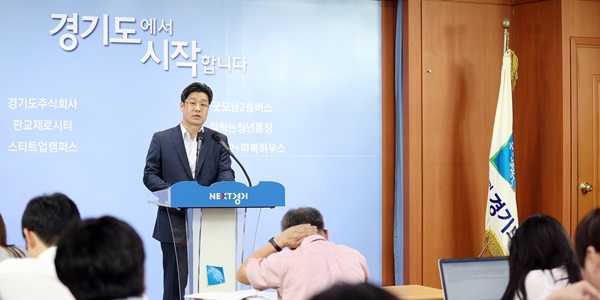
Gyeonggi Province has compiled a third supplementary budget proposal worth 22.3086 trillion won and submitted it to the Gyeonggi Provincial Assembly on the afternoon of the 16th.
This represents an increase of 2.5189 trillion won compared to the second supplementary budget of 19.7897 trillion won.
The province emphasized that in compiling this supplementary budget proposal, it placed the greatest weight on revitalizing the local economy through job creation.
Oh Byung-kwon, Director of Planning and Coordination for Gyeonggi Province, held a briefing and explained: "We compiled the budget with four main points in mind: prioritizing budget allocation for local economic revitalization, establishing safe and convenient transportation infrastructure, expanding investment in fire services and safety sectors to protect residents' lives, and reflecting welfare business support and mandatory expenditures."
First, 34.9 billion won was allocated as funds for revitalizing the local economy. ▲124 billion won for small and medium enterprise support including the Hwaseong Jeonggok Marine Industrial Complex development project and sales channel support for Gyeonggi Province's co-branded quality products ▲165 billion won for expanding cultural and sports facilities including the renovation of the Gyeonggi Province Comprehensive Shooting Range ▲60 billion won allocated as budget for job creation including training of next-generation visual content creators.
Second, 1.3 trillion won was allocated as funds for establishing safe and convenient transportation infrastructure. ▲1.051 trillion won for road construction projects including the Siheung Cheonwang-Gwangmyeong Metropolitan Highway and Yangju Ganap-Sangsu Local Road construction ▲114 billion won for road pavement and structure maintenance management, ▲121 billion won allocated for support including the introduction of double-decker buses.
Third, a total of 31.2 billion won was allocated to expand investment in fire services and safety sectors. ▲37 billion won for welfare support including fire officials' uniforms and health checkups, ▲82 billion won for rescue and first-aid equipment and fire vehicle reinforcement, ▲52 billion won for the land purchase of the Daehwa 119 Safety Center new construction and community safety autonomous projects, ▲17 billion won for CCTV installation for crime prevention, ▲124 billion won reflected for flood and drought prevention river improvement projects.
Fourth, a total of 68.6 billion won was allocated in the field of tailored welfare and childcare expansion. ▲482 billion won for infant childcare fees and home childcare allowances, ▲177 billion won for basic livelihood security and medical assistance for low-income groups, ▲12 billion won for strengthening the function of public medical institutions, ▲15 billion won for operation cost support including personnel expenses at welfare facilities, etc.
By accounting category, it consists of 17.7961 trillion won in general accounts and 4.5125 trillion won in special accounts with designated purposes such as Pangyo Techno Valley and medical assistance funds.
The 17.7961 trillion won in general accounts represents an increase of 1.5405 trillion won, or 9%, compared to the second supplementary budget. This was largely due to increased land transaction volume.
According to provincial tally, tax revenues increased by 70 billion won, local transfer taxes by 1.12 billion won, and national treasury subsidies by 17.84 billion won, respectively. This includes an increase of 59.44 billion won in acquisition tax and an increase of 10.06 billion won in local education tax.
General account expenditure budgets are predominantly comprised of 109.48 billion won in total mandatory and legal expenditures including 54.26 billion won in city and county disbursements, 33.03 billion won in education office transfers, and 12.83 billion won in local bond repayment reserve fund transfers. Additionally, 24.06 billion won was allocated to projects with designated purposes such as national treasury subsidy projects, and 20.51 billion won in self-funded project budgets.
The 4.5125 trillion won in special accounts represents an increase of 97.84 billion won, or 28%, compared to the second supplementary budget. Public enterprise special accounts increased by 75.97 billion won to 3.0942 trillion won, and other special accounts increased by 21.87 billion won to 1.4183 trillion won.
This supplementary budget proposal by Gyeonggi Province will undergo review by the Gyeonggi Provincial Assembly from the 26th of this month through the 9th of next month before being finalized.
Loading comments…