


I Will Improve the Underdeveloped Educational Environment
Suwon Ilbo has prepared interviews with candidates from the Suwon area running in the June 5 by-election for local offices. The interviews posed common issues to candidates in each electoral district. The following are candidates running in the by-election for Gyeonggi Province Councilor from Suwon City District 4, listed by ballot number. <Editor's Note>
"The west Suwon area has fallen behind in education and economy. Now Park Byung-hwan will step forward and make a change."
Candidate No. 3 Park Byung-hwan (40, male, adjunct professor at Yongin Songdam University), running in the by-election for Gyeonggi Province Councilor from Suwon City District 4, has made improvement of the educational environment in the west Suwon area his top priority pledge, befitting his status as an education expert.
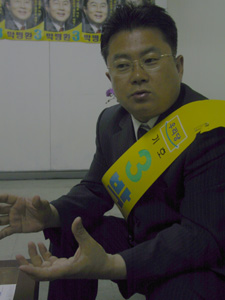 | ||
| ▲ Candidate No. 3, Park Byung-hwan of the Open Our Party, running in the by-election for Gyeonggi Province Councilor from Suwon City District 4. | ||
Regarding the recent controversy over the abolition of 0-period classes and voluntary study sessions, Park said, "There are pros and cons, but the issue is how to resolve this problem according to residents' demands." He added, "If elected, I will work as an education committee councilor, conduct field investigations and gather public opinion within the region, and then enact ordinances reflecting residents' consensus to resolve the issue."
On the controversial issue of specialized high schools, Park stated, "The Korean Teachers and Education Workers Union opposes them citing destruction of educational equality, but I would not oppose specialized high schools if they operated according to their original purpose." He noted that "the limitation is that specialized or foreign language high schools are currently viewed merely as special schools for university entrance exams," and explained, "For them to operate in line with their original purpose, both specialized and foreign language high schools should implement the department system currently used in universities, allowing students to make careful choices and ensuring that their corresponding advantages are reflected in the university admissions system."
Park currently also serves as representative of the Korean International School in Heilongjiang Province, China.
- What prompted you to run in this by-election?
First, the moderate reformist orientation of the Open Our Party aligns with my character, which led me to enter politics.
The Open Our Party is neither too radical while maintaining a reasonably reformist orientation. The same goes for me.
Having lived in the Gwonseon area since elementary school, I have developed significant awareness of local issues such as education and aircraft noise problems.
My political orientation combined with my long-held concerns about these issues, naturally leading me to step into the political arena, and there was considerable encouragement from those around me.
- What are your key pledges? 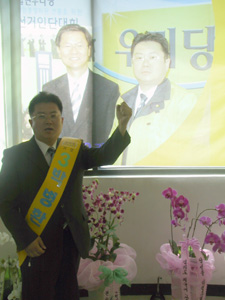
▲ Candidate Park is positioning educational environment improvement as his central pledge.
First, I will work to improve the educational environment.
Regarding school meals, which are the most problematic issue, I will make the entire process transparent from vendor selection, analyze the causes of inadequate meal quality, and ensure our children receive high-quality food.
Additionally, since Gwonseon District has far fewer high schools compared to other areas, I will pursue high school construction to enable students to attend school without long commutes.
While Gwonseon District with a population of about 280,000 residents has only 6 high schools, Jangan District with about 230,000 residents has as many as 18.
Beyond this, I will push for relocation of Suwon Air Base to areas north of Gyeonggi Province where residents do not live, and will work on the underground placement of the Suin Line railway.
Particularly, I will establish a west Suwon development and development forum to gather opinions from residents interested in west Suwon development across generations and reflect them in policy.
- Last April, Gyeonggi Province Council referred members of local civic organizations opposing the relocation of the U.S. military base in Pyeongtaek to police on charges of obstruction of official duties. Currently, 7 of the referred individuals are standing trial. What is your view on this situation?
Both sides are people working for the provincial residents.
This should be resolved well.
I believe this problem arose because both sides lacked dialogue and mutual distrust ensued.
In social democratization, violence should never occur, and such issues should always be resolved through dialogue and compromise.
If elected, I will always work to provide venues for dialogue.
- The Participatory Government has presented national balanced development through decentralization and dispersal policies as key policy initiatives. The Gyeonggi Province Governor and others have raised reverse discrimination arguments in opposition. What is your position on this controversial issue?
I am not sure about other regions.
In the case of west Suwon, it must continue to develop going forward.
I am concerned that this bill may become an obstacle to west Suwon development, but I basically agree with the policy's intended purpose of preventing reckless development and achieving balanced regional development.
- The citizen recall system, which asks for confirmation of officials who do not work hard or lack qualifications, has recently emerged as a topic of discussion.
There are strong calls for this system to be implemented in local governments as well. What is your view?
Of course, the basic purpose is good. I believe this is a system that should be introduced in the future.
However, now is premature.
Comparing the United States, which already implements this system, with Korea, considering our national characteristics, I do not believe this is a system to be introduced immediately.
There is a risk this system could be exploited for political purposes and may even encourage social conflict.
<Biography>
Graduated from Bibong High School. Graduated from Seoul National University with a degree in Business Administration. Completed Master's degree in English Education from Kookmin University Graduate School of Education. Former chairman of Suwon City Academy Federation. CEO of ECY Kids School. Board member of Suwon City Volunteer Coordination Council. Vice Chairman of the National Council for Foreign Language Education. Adjunct professor in English Department at Yongin Songdam University. Former vice chairman of Suwon City School Steering Committee Chairpersons Council. Deputy Chairman of the Open Our Party's Capital Region Balanced Development Special Committee.


Loading comments…