


Gov. Choo Mi-ae Under Fire Over "Full Ownership" Controversy as Over 30,000 Sign Resignation Petition
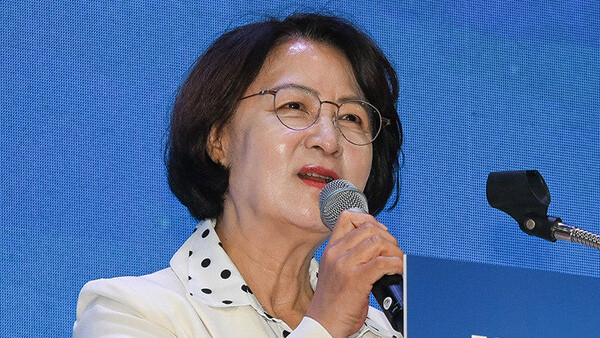
Gyeonggi Province Governor Choo Mi-ae declared a "fiscal emergency" shortly after taking office and launched sweeping austerity measures affecting civil welfare projects and employee expenses. However, she is now facing a "full ownership" controversy after arranging a new official residence and official vehicle for her own use, spending approximately 1.3 billion won.
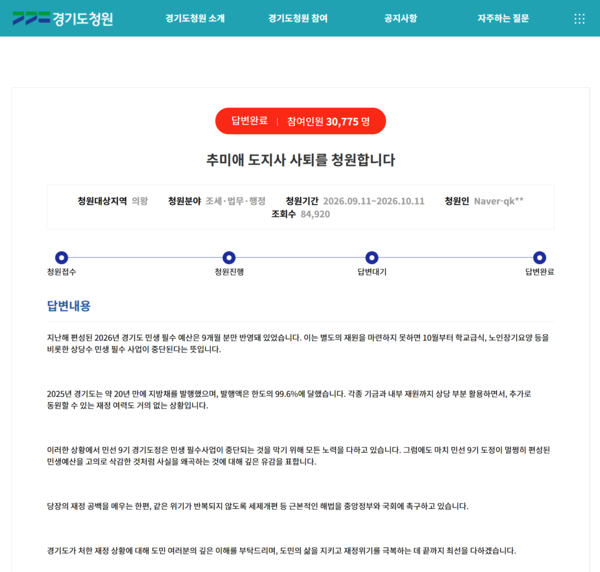
According to Gyeonggi Province officials on the 15th, the petition titled "We urge Governor Choo Mi-ae to resign," posted on the 11th, has surpassed 30,000 signatures. This marks the first time a resignation petition against a sitting Gyeonggi Province governor has garnered more than 10,000 signatures to meet the threshold for an official response.
The petition stems from Governor Choo's declaration of a "fiscal emergency" following her inauguration.
Last month, Governor Choo designated Gyeonggi Province's finances as essentially in a crisis situation and initiated a structural adjustment of expenditures totaling 500 billion won. She lowered the province's funding ratio for municipal and county subsidized projects and reduced internal expenses including operational budgets and employee incentives.
Citizen-focused projects also became targets for structural adjustment.
The postpartum care allowance, which has provided 500,000 won per newborn, will only be disbursed for babies born through September, meaning families with children born in October through December of the same year were excluded from the support program.
The province explained that this year's civil welfare essential budget reflected only nine months of funding, and without securing additional resources, numerous projects including school meals and long-term care for the elderly would be suspended starting in October.
Meanwhile, criticism emerged that expenditures related to Governor Choo herself contrasted with the austerity approach.
The province contracted an apartment serving as the governor's official residence with a deposit of 1.22 billion won and a private usable area of 156 square meters, approximately 47 pyeong.
The official vehicle was also newly purchased. The contract amount was 77.65 million won, arranged with Hyundai Motor Company through selective bidding and a total cost contract method.
The residence and vehicle combined amount to approximately 1.3 billion won.
This is the backdrop for the so-called "full ownership" criticism that the governor imposed austerity on citizens and civil servants while applying different standards to her own official residence and vehicle.
Against this backdrop, the resignation petition emerged.
The petition organizer argued that Governor Choo's use of the term "bankruptcy" was excessive, noting that Gyeonggi Province's debt-to-budget ratio falls below the legally designated fiscal crisis threshold.
The petition also cited the reduction in municipal and county subsidy ratios, adjustments to civil welfare budgets, and the official residence issue, demanding that she "acknowledge her inability to take responsibility for the lives of 14 million Gyeonggi residents and resign of her own accord."
When the petition reached 10,000 signatures, the province posted an official response, and the petition is currently marked as "Response Completed."
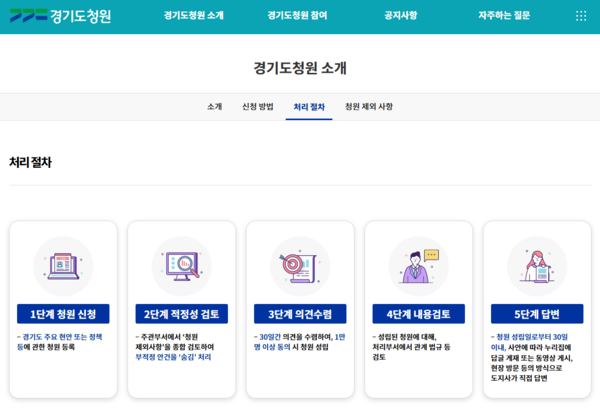
The Gyeonggi Province petition system requires 10,000 or more signatures within 30 days for a petition to be established, and the official processing procedure mandates that the governor personally respond within 30 days of establishment.
Gyeonggi Province changed its petition response method from the existing "response by department head or governor" to "direct response by governor" in 2023, citing enhanced accountability as the reason for the procedural reform.
However, the actual petition page displays a response under the name "Gyeonggi Province" rather than under Governor Choo's personal name.
In its response, Gyeonggi Province stated, "The 2026 Gyeonggi Province civil welfare essential budget that was formulated last year reflected only nine months of funding," and "If additional resources cannot be secured, numerous civil welfare essential projects including school meals and long-term care for the elderly will be suspended starting in October."
The province further explained, "In 2025, Gyeonggi Province issued local bonds for the first time in approximately 20 years, with the issuance amount reaching 99.6% of the limit," and "With substantial portions of various funds and internal resources already utilized, there is virtually no additional fiscal capacity available."
It added, "The 9th civilian administration of Gyeonggi Province is making every effort to prevent the suspension of civil welfare essential projects," and expressed "deep regret at the distortion of facts by making it appear as though the 9th civilian administration deliberately cut civil welfare budgets that were properly established."
Despite Gyeonggi Province adopting the "direct response by governor" principle citing enhanced accountability, the response to a petition demanding the governor's own resignation bears unclear authorship.
Beyond the controversy over fiscal responsibility and the necessity of austerity measures, further debate is expected regarding how Governor Choo, who has been demanding shared sacrifice from citizens and civil servants, has responded responsibly to the resignation demands from approximately 30,000 people.


Loading comments…