


Gwangmyeong City Changes 'Conflict Response Paradigm' in Redevelopment Projects
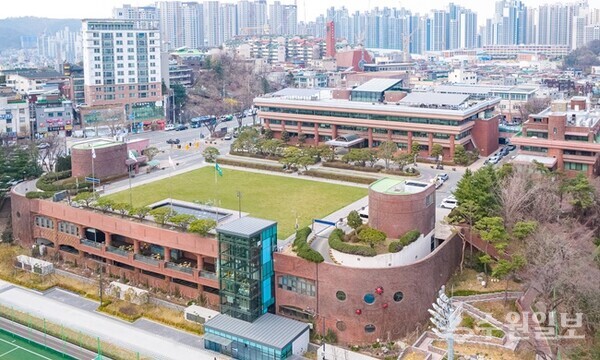
[Suwon Ilbo=Reporter Yu Je-seong] Gwangmyeong City is launching proactive public management policies aimed at reducing conflicts and project delays that have been repeated in the process of various redevelopment projects including redevelopment, reconstruction, and public redevelopment.
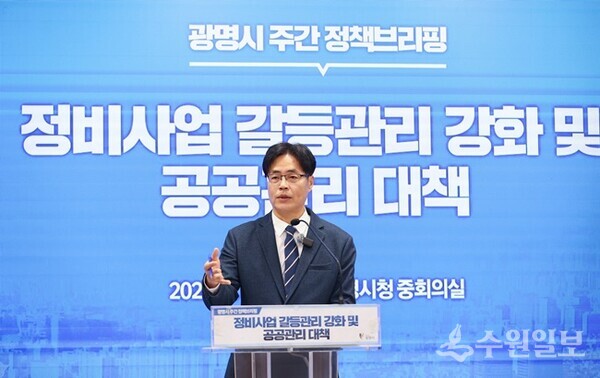
The city held a policy briefing on the 26th in the morning in the conference room under the theme of 'Enhanced Conflict Management and Public Management Measures for Redevelopment Projects,' announcing that it will pursue 5 major policies to transition from passive 'licensing administration' to 'proactive management and support.'
This policy includes △operating a dispatch system for conflict resolution experts (coordinators) △standardizing operational inspections of redevelopment projects △strengthening management of trust-based redevelopment projects △reinforcing resident and civil servant education △enacting ordinances for support and management reinforcement of redevelopment projects.
Among these, 4 implementation policies will be fully implemented by the end of Q2, while the ordinance to provide institutional support is targeted for enactment by Q3.
Lee Sang-woo, Head of the New Town Development Division, stated, "Redevelopment projects go beyond simple development to create citizens' lives and the future of communities, so the role and responsibility of the public are important." He added, "The city will respond proactively to conflicts and responsibly manage the entire project process to restore public trust in redevelopment projects and lead this toward creating stable residential environments."
■ Shifting from Post-Conflict Response to Prevention… Dispatching Field Experts
The city is changing its conflict response paradigm from 'post-processing' to 'preventive' focus.
To achieve this, the city will fully launch the 'conflict resolution expert (coordinator) dispatch system' starting from Q2, dispatching field specialists in urban redevelopment, law, real estate appraisal, and other fields directly to sites.
When signs of disputes are detected in each redevelopment district, experts will be immediately deployed to block conflict escalation and derive rational mediation proposals at the initial stage.
Coordinators will serve as communication channels between project implementers and residents, taking on substantial coordination tasks including △checking major issues at each project stage △diagnosing potential risks △analyzing causes of disputes △presenting mediation proposals. Rather than merely handling civil complaints, the plan is to analyze the structural causes of conflicts and present prevention-focused solutions.
■ Standardizing Operational Inspections of Redevelopment Projects… Increasing Trust Through Full-Process Monitoring
The city will standardize operational inspections of redevelopment projects at each stage to enhance integrity and transparency.
The city will form an inspection team consisting of approximately 40 specialists in redevelopment, including lawyers, tax accountants, urban planners, and real estate appraisers, and systematically inspect the operational status of project implementers (cooperatives, trust companies, etc.), appropriateness of general assembly procedures, project fund execution details, and compliance with redevelopment plans from Q2 onwards following designation of redevelopment districts.
Inspection results will be transparently disclosed to cooperative members and residents to resolve information asymmetry, and when violations are confirmed, strong administrative measures will be imposed to encourage early normalization.
Through this, the city plans to establish a foundation for the public to manage and supervise all stages of redevelopment projects.
■ 6 of 8 Districts in Ha-an-dong Using Trust Method… Strengthening Management Through On-Site Presence and Cooperation Councils
Considering that 6 of 8 redevelopment districts in Ha-an-dong are being pursued through the trust method, the city will further strengthen the public management system for trust-based redevelopment projects.
Trust-based redevelopment projects are pursued by designating a trust company as the project implementer instead of establishing a cooperative, and have been rapidly expanded following the special provisions of Article 101-8 of the 'Urban and Residential Environment Improvement Act' implemented in January 2024.
Since the introduction of the system, management standards and operational cases have not been sufficiently accumulated compared to the cooperative method, making it necessary to establish more systematic and clear management standards.
Accordingly, the city will have trust company staff stationed on-site from project implementer designation until integrated review application to strengthen communication between residents and trust companies.
Through this, distrust in the decision-making process will be reduced, and a foundation will be established to quickly share and coordinate when major issues arise.
Additionally, regular cooperation councils between the city, residents, and trust companies will be operated to ensure that cooperation systems for trust-based redevelopment projects are stably established.
The plan is to establish a practical resident-participatory redevelopment project structure that regularly shares project progress and conducts advance checks on major issues.
Furthermore, the city will cooperate with the Financial Investment Association, which oversees trust companies, to ensure that such structures operate effectively.
The Association will be responsible for supporting educational programs on trust methods targeting residents, providing expert consultation and coordination support for disputed projects, and offering support to strengthen conflict prevention and management capabilities including establishing management standards and providing consulting.
■ Professional Instructors Participating… Strengthening Resident and Civil Servant Education to Close Information Gap
The city is also strengthening its education system to reduce misunderstandings and distrust arising from insufficient information.
Based on a business agreement concluded in April 2025 with the Korea Real Estate Board, the city plans to have experts dispatched from the Board participate as instructors for redevelopment project education. Through this, the plan is to provide more objective and professional education and increase policy trust.
For residents, the city will expand customized educational programs addressing major issues such as redevelopment procedures, cooperative management structures, and methods for calculating right values to increase project comprehension. Through accurate information delivery, the plan is to preemptively block conflicts caused by unfounded rumors or distorted information.
Additionally, routine specialized practical training will be provided to civil servants in charge of redevelopment projects regarding relevant laws and regulations, accounting, and cooperative management. The plan is to provide more objective and consistent administrative services while combining external expert-linked education with establishment of practical manuals.
■ Enacting Ordinance for Management Reinforcement by Q3… Institutionalizing Public Responsibility
The city plans to enact the 'Ordinance for Support and Management Reinforcement of Redevelopment Projects' by Q3 to provide institutional support for the 4 implementation policies mentioned above.
This ordinance enactment reflects the city's strong commitment to strengthening public responsibility throughout the entire redevelopment project process and conducting more transparent and fair administration.
The ordinance will specify public management and support roles including expert coordinator dispatch, operational inspections, and education support to ensure policy continuity and effectiveness.
Additionally, the ordinance will institutionalize the holding of resident briefing sessions to ensure that landowners' opinions are sufficiently gathered from stages prior to the urban planning proposal stage, establishing a resident participation foundation from the initial stage.
Prior to entering into construction contracts with apartment construction companies, the city will support consulting by the Korea Real Estate Board to establish a preliminary inspection system to prevent unfavorable or dispute-prone clauses from being included in contracts.
Based on these 5 major policies, the city plans to strengthen transparency and accountability throughout the redevelopment project process, minimize project delays and social costs resulting from conflicts, and establish a successful redevelopment administration model.


Loading comments…