


Focus on 'Human-Centered' Transportation Policy
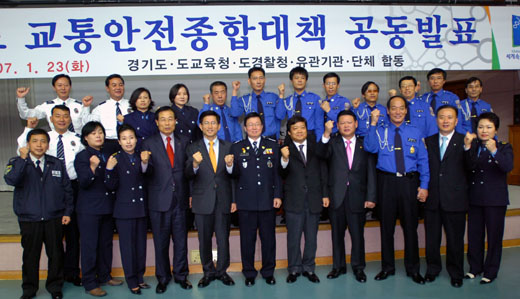
On July 23, Gyeonggi Province established a comprehensive traffic safety plan that shifts focus from 'vehicle-centered' transportation policies to 'human-centered' policies.
The province will first prepare tangible safety measures by improving traffic facilities, while strengthening efficiency through 'lateral connections' with police, the education office, and civic organizations.
In addition to 'hardware' measures such as installing traffic safety facilities, the province will also prepare 'software' improvements such as raising public awareness. Furthermore, it will ensure these measures do not become one-time events through continuous inspection and evaluation.
Through these efforts, the province aims to shed the stigma of having the highest traffic fatality rate in the nation with 1,200 deaths last year, and set a goal to reduce that number to 735 by 2010.
◇Improvement and Expansion of Road Safety Facilities
The province first plans to reduce traffic accident rates in a short period by improving traffic safety facilities and the traffic system.
The province will select eight pilot areas and gradually transition to a European-style traffic signal system that moves the position of traffic lights currently installed across intersections to before crossing, preventing signal violations and premature departures.
The province will also expand the Bus Rapid Transit (BRT) system to the Anyang-Gwacheon 11 corridors spanning 133.9 kilometers, following Goyang.
Additionally, in February, the province will designate four cities and counties where various types of traffic accidents occur as 'traffic safety pilot cities' and conduct safety diagnoses suited to local characteristics. The province plans to analyze traffic accident increase and decrease rates through three years of pilot city operations and expand them to all cities and counties.
The Gyeonggi Provincial Police Agency will also push forward signal coordination by assigning signal times appropriate to traffic volume, replacing the current stop-and-go signal system, to ensure smooth traffic flow.
◇Establishing Basic Traffic Order and Enhancing Safety Awareness
No matter how much investment is made in traffic safety facilities, it becomes useless if drivers' awareness does not follow.
The police agency will conduct intensive selective enforcement against violations such as drunk driving, speeding, and signal violations that have high potential for accidents.
In particular, starting with the Seohae Bridge section in the second half of this year, the agency will focus on deploying 'section speed violation detection systems' at the beginning and end points of bridges and tunnels to prevent accidents.
In return, traffic police will be deployed at intersections prone to tail-gating and habitual lane-cutting, and for minor traffic law violators, the agency will implement traffic administration focused on guidance rather than enforcement through the use of 'traffic order cooperation request forms'.
Meanwhile, the Gyeonggi Provincial Office of Education will solicit traffic safety slogans in September and hold safe living practice presentation meetings to raise public safety awareness.
◇Pedestrian Safety Measures for Children and Elderly
The province will complete safety facility improvement projects in school zones including the installation of speed bumps and skid-resistant facilities and separation of sidewalks and roadways three years ahead of schedule by 2008.
The education office will create 'traffic safety learning mileage passbooks' to score children based on their compliance with traffic laws and commend excellent schools and students.
The office will also produce a traffic accident risk map titled 'Dangerous Areas Here' and use it to recommend facility improvements to relevant agencies and conduct traffic safety education for children.
The police agency will designate elderly protection zones near elderly welfare facilities such as nursing homes and senior centers in preparation for an aging society, and distribute 'senior marks' for elderly drivers to reduce traffic accidents involving senior citizens.
Additionally, the province will extend pedestrian crossing time at crosswalks from 21 seconds (based on a four-lane road) to 24 seconds to prevent jaywalking by elderly and children.
◇Strengthened Traffic Safety Management for Commercial Vehicles
Gyeonggi Province and the Road Traffic Authority will designate transportation companies with traffic accident rates in the top 10 percent among 511 companies within the province that own 20 or more vehicles as special inspection targets and intensively inspect compliance with safety standards.
The province also plans to strengthen safety education for 100,000 commercial vehicle drivers including buses, taxis, and cargo vehicles to reduce traffic accident fatality rates.
◇Strengthening Cooperative Agency Networks
The province, police agency, and education office will comprehensively evaluate traffic safety measures including traffic accident occurrence rates and safety measure implementation results by city and county, and provide incentives to the top three performing cities and counties.
Additionally, to jointly promote traffic safety measures, the province will establish networks with seven private traffic safety organizations such as the Exemplary Driver Association, 14 transportation business associations including bus associations, and four traffic safety-related agencies including the Road Traffic Authority to create a robust traffic safety network.

Loading comments…