


Lee Jae-myung Recommends Disposal of Non-Residence Properties by High-Ranking Officials and Public Institution Executives
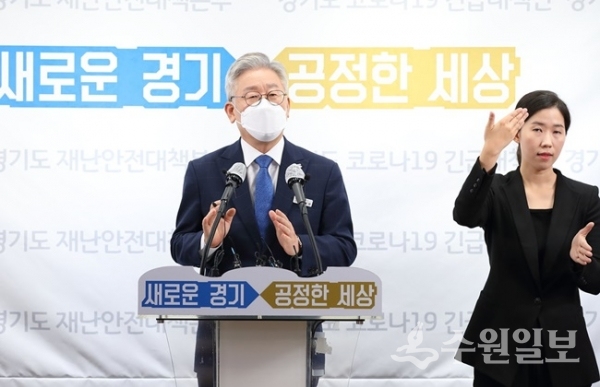
[Suwon Ilbo=Park No-hoon, reporter] Gyeonggi Province Governor Lee Jae-myung on the 28th strongly recommended that Gyeonggi Province civil servants and public institution executives holding multiple properties dispose of all properties other than those they reside in by the end of this year.
The multi-property disposition measure for high-ranking officials is the first among local governments and is stronger than the government's recommendation to only Grade 2 and above officials, with the province planning to reflect high-ranking officials' housing possession status in personnel evaluations from next year.
Governor Lee Jae-myung held an online briefing at Gyeonggi Provincial Government on this day and announced "Major Real Estate Measures for Gyeonggi Province" with such content.
At the occasion, the governor stated, "To realize President Moon Jae-in's precise diagnosis and conviction that 'real estate cannot be used to make money' and to subdue the real estate craze, we must create and implement policies that are meticulous and have high public acceptance," adding, "While it is difficult to create fundamental measures due to the limitations of local government roles, with the determination that we must do whatever we can to prevent disastrous real estate speculation, Gyeonggi Province has prepared several major real estate measures."
The major real estate measures announced on this day include ▲recommendations to dispose of properties beyond one residence for high-ranking officials as a measure to restore trust in real estate policy ▲basic housing supply plan for Gyeonggi Province as a means to expand housing supply and reduce speculative demand ▲proposal to introduce basic income land tax as a measure to recover unearned real estate income.
□ Recommendation for high-ranking officials to sell properties beyond one residence and measures to restore trust in real estate policy
Regarding measures to restore trust in real estate policy, the governor stated, "When people with interests in real estate are involved in real estate policy decisions, it is difficult to make good policies," and added, "We will seek cooperation from the National Assembly and central government to introduce a real estate blank trust system that prevents high-ranking officials from holding any real estate other than essential residential or business properties, and will work to realize legislation."
He also explained, "However, we cannot wait only for legislation, so we have prepared interim countermeasures against high-ranking officials holding multiple properties for speculation and investment purposes."
Accordingly, the province first targeted Grade 4 and above civil servants under Gyeonggi Provincial Government, vice heads of municipal governments and counties, full-time executives of provincial public institutions, and executives above bureau chief level (for Gyeonggi Housing & Urban Development Corporation, considering its characteristics as a housing policy institution, including executives at bureau chief level), strongly recommending they dispose of properties exceeding one residence by year-end. Additionally, if multiple properties must be held due to unavoidable circumstances, such circumstances must be resolved within six months of their occurrence.
In case of non-compliance with the recommendation, the province plans to reflect housing possession status in personnel decisions from next year, including promotions, transfers, and performance evaluations, to exclude multi-property holders from relevant duties, and to reflect this in the reappointment (contract renewal), promotion, and public institution management evaluations for public institution executives. During the briefing, the governor disclosed that "There has already been a case this year where a high-ranking official was excluded from promotion for holding multiple properties."
According to provincial investigation, among 332 Grade 4 and above officials under the province, 94 are multi-property holders, accounting for 28.3% of the total. Those holding two properties were the most numerous at 69 people, those with three properties numbered 16, and officials and executives holding four or more properties were counted at 9. In particular, the governor detailed multi-property holder status by affiliated organization, municipal vice heads, fire and disaster management headquarters, and public institution executives, making clear the policy implementation will.
□ Expansion of housing supply including Gyeonggi Province basic housing and reduction of speculative demand
As a second point, the governor stated, "Just as important as new housing supply is reducing housing purchase demand, so we must supply sufficient stable and necessary long-term public rental housing to allow people to choose renting instead of purchasing," and added, "We plan to supply 'Gyeonggi Province Basic Housing' as a universal public asset differentiated from existing public rental housing for low-income groups, with 50% or more of housing supply quantities to be basic housing starting from the third new cities."
The governor explained Gyeonggi Province basic housing on this day, dividing it into long-term public rental type and rental-conditional sales housing.
First, the long-term public rental type is ultra-long-term public rental housing that anyone without a house can move into, located in the best locations such as transit-oriented areas, differentiating it from existing rental housing built in areas with poor residential conditions and targeting low-income residents.
Aiming to ensure that any household without housing enjoys the right to a stable residential environment in urban transit-oriented areas for 30 years or more, appropriate rental rates at a level enabling cost recovery will be set. Housing size and quality will also be supplied at levels that middle-class and above households can sufficiently satisfy.
The rental-conditional sales type is a housing form where the developer retains land ownership while purchasers own the building and welfare facilities, differing from the current apartment sales format where purchasers own both land and housing. Since the developer retains land ownership, there is no speculation concern and there is the advantage of lower prices compared to general sales apartments. The province plans to introduce it as a pilot project in third new cities through Gyeonggi Housing & Urban Development Corporation, and plans to expand implementation after analyzing project outcomes. For project success, the province plans to pursue amendments to related laws and enforcement ordinances such as the Housing Act, raising floor area ratios, and reducing housing and urban fund loan rates.
Separate from public rental housing, the province will also launch a pilot project for "Gyeonggi Province Social Housing," where the state owns the land and rents it for 30 years or more, and social cooperatives own and operate the buildings. "Gyeonggi Province Social Housing" reduces the burden of land purchase by having social cooperatives hold land owned by the public on a long-term lease of 30 years or more, and through this effect, cooperatives supply housing at rental rates of 80% of surrounding market rates. Sixty percent will be provided through general public recruitment, and 40% through special supply targeted at low-income households, people with disabilities, single-person households, and elderly residents. The pilot project recruitment begins in October this year.
□ Request for new approach to real estate taxes including basic income land tax
As a third point, the governor stated, "South Korea's unearned real estate income reaches 346 trillion won, or 22% of GDP. Some of the unearned income generated from land, a collective asset, must be recovered through taxation and shared equally among all members," and argued, "It is necessary to introduce a basic income land tax that does not consume collected taxes as general revenue but refunds them fairly to all citizens."
He continued, "As seen in this disaster support payment, in the post-COVID era where systematic low growth becomes commonplace due to demand cliffs, basic income paid in local currency will function as an important economic and welfare policy driving sustained economic growth through expanded consumption capacity," and recommended to the government that "under the condition of fully refunding the tax increase as basic income, bold increases in real estate taxes that can eliminate speculative demand and sufficiently stabilize real estate prices, and introduction of local currency-type basic income (basic income land tax) should be implemented."
The governor also stated, "If we raise the current land holding tax effective rate of only 0.16% to the OECD average level of 0.5%, an increase in tax revenue of 6.3 trillion won is expected in Gyeonggi Province alone," and requested cooperation from the government and National Assembly, saying, "If nationwide implementation of basic income land tax is difficult, please allow provinces that wish to independently introduce basic income land tax."


Loading comments…