Province surveys 1,000 Gyeonggi Regional Currency merchant establishments on disaster basic income effectiveness compared to COVID-19 spread period56% of merchants perceive "monthly sales increase"...Recovery to 79% of pre-COVID-19 sales levels89% positive evaluation of Gyeonggi Province disaster basic income80% say it "will help" overcome management difficulties; 52% say it "helped" with withdrawal of closure and business downsizing plans
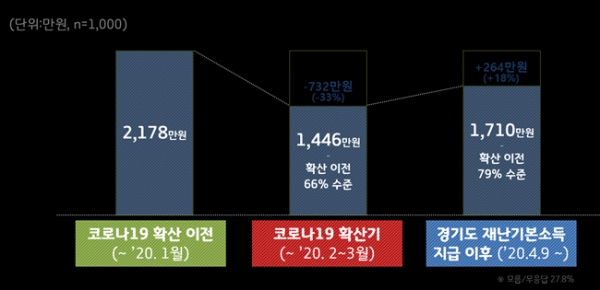
Chart showing monthly sales levels after Gyeonggi Province disaster basic income distribution.
[Suwon Ilbo=Park No-hun] A survey shows that monthly sales at self-employed business establishments in Gyeonggi Province increased by 18% compared to February and March, when COVID-19 was spreading, following the distribution of the province's disaster basic income. Self-employed monthly sales recovered to 79% of pre-COVID-19 levels.
The province conducted a survey from May 6 to 8 on 1,000 Gyeonggi Regional Currency merchant establishments regarding the impact of COVID-19 and the effectiveness of the Gyeonggi Province disaster basic income, announcing the results on May 14.
According to the survey results, 56% responded that monthly sales "increased," exceeding half. By business category, the food and beverage sector showed the highest response of 77% for "increase," and by commercial district type, traditional market areas showed the highest response of 67% for "increase."
Estimating the average monthly sales of self-employed establishments before and after the Gyeonggi Province disaster basic income distribution, sales decreased 33% from 21.78 million won before COVID-19 spread to 14.46 million won during the spread period (February-March), but increased 18% to 17.1 million won after the Gyeonggi Province disaster basic income distribution. This represents 79% of pre-COVID-19 sales levels, indicating a relatively strong recovery.
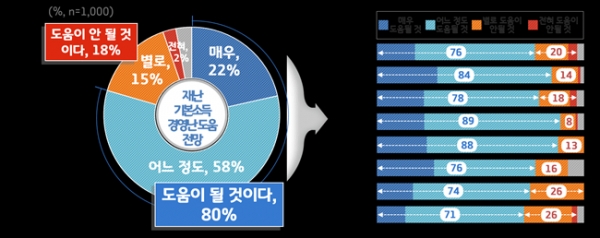
Whether Gyeonggi Province disaster basic income helped overcome management difficulties.
80% of merchant establishments predicted that the disaster basic income will help self-employed and small business owners overcome management difficulties, and 52% of merchant establishments responded that it "helped" with the withdrawal of closure and business downsizing plans among self-employed and small business owners.
Regarding sales at the end of August, when Gyeonggi Province disaster basic income usage ends, 48% of merchant establishments, nearly half, forecast that sales will "increase" compared to February and March.
Additionally, 89% of Gyeonggi Regional Currency merchant establishments positively evaluated the Gyeonggi Province disaster basic income distribution.
During February and March, when COVID-19 spread continued, self-employed sales in the province decreased at the majority of establishments (89%). In particular, 21% of respondents experienced temporary closures, with 34% lasting four weeks or longer. Operational changes including ▲reduction in business hours (41%) ▲reduction in number of employees and part-time workers (22%) ▲reduction in employee and part-time worker hourly wages (8%) were also observed.
For measures to address economic difficulties, ▲loans from financial institutions and ▲liquidation of savings and use of emergency funds each accounted for 23%, followed by ▲applications for support from government, local governments, and public institutions (15%) and ▲loans through acquaintances or referrals (10%) (multiple responses).
Kwak Yun-seok, Public Relations Director of Gyeonggi Province, stated, "We have confirmed that the Gyeonggi Province disaster basic income is serving as a foundation for recovery of the local economy," and added, "We will conduct active promotional campaigns to ensure that all 13.4 million residents apply and quickly consume the benefits."
The survey was commissioned by Gyeonggi Province to Korea Research, a polling agency, and was conducted via telephone interviews with 1,000 Gyeonggi Regional Currency merchant establishments from May 6 to 8. The confidence level is 95% with a margin of error of ±3.09%p.





Loading comments…