


Capturing Methane from Space... 'Gyeonggi Climate Satellite 2' Enters Orbit
Entered Target Orbit...Ground Station Communication Successful
Gyeonggi Province has become the first local government across the country to successfully launch its own artificial satellite into space to directly measure atmospheric greenhouse gases.
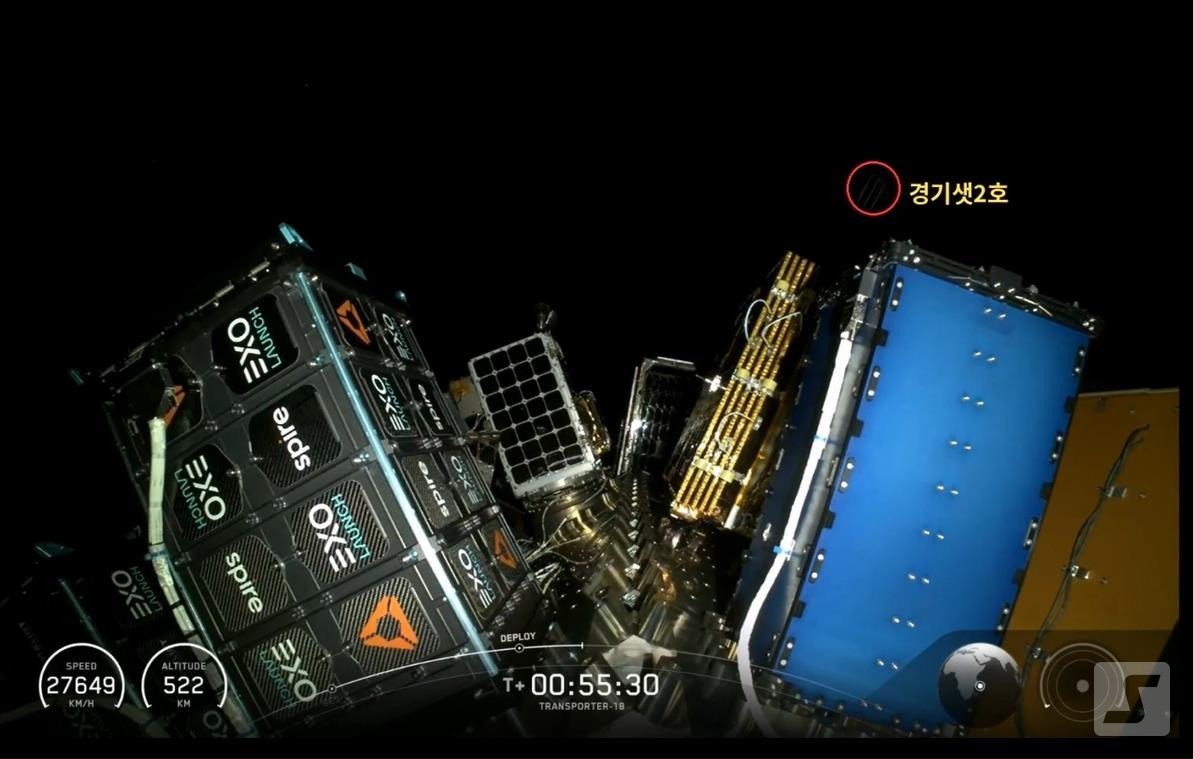
On the 2nd at 3:32 a.m. (Korea time), Gyeonggi Province launched 'Gyeonggi Climate Satellite 2A (GYEONGGISat-2A)' aboard SpaceX's 'Falcon 9' launch vehicle from Vandenberg Space Force Base in California, and announced that it successfully entered its target orbit and completed initial communications with ground stations without any issues.
Precisely Capturing Methane Emission Sources with Stronger Greenhouse Effect
This launch of the second satellite was undertaken to precisely monitor emission sources of methane (CH₄) gas, which has a more powerful greenhouse effect than carbon dioxide.
The ultra-compact satellite, based on a 25-meter spatial resolution, can observe an area of 10.5 km x 10.5 km at a time and accurately pinpoint locations where more than 100 kg of methane per hour is being emitted. The second satellite will henceforth conduct dedicated observations of major landfills, power plants, and industrial complexes throughout the province for more than three years.
Building 'Greenhouse Gas Observation Map' Based on Real Measurement Data
While methane has a short atmospheric residence period, its powerful greenhouse effect makes precise identification of emission sources and rapid reduction critical to responding to the climate crisis. Gyeonggi Province plans to establish a scientific management system that moves away from relying on documented emission statistics or estimates, instead directly reflecting real measurement data captured by satellites in governance.
The collected data will be linked with the 'Gyeonggi Climate Platform' and transformed into a 'Greenhouse Gas Observation Map' that provides an overview of emission status at a glance. This will serve as essential reference material for industrial complex greenhouse gas reduction consulting and carbon neutrality policy establishment.
Satellite 3 Joins in 2027...Three-Satellite Three-Dimensional Observation Network Complete
Gyeonggi Province previously launched its first satellite, a 1.5-meter-class high-resolution optical satellite for disaster monitoring, in November of last year. The province plans to additionally launch 'Satellite 3 (GYEONGGISat-2B)', which will perform identical greenhouse gas observation missions, in the first half of 2027 to establish an independent climate satellite observation network with a total of three satellites.
Once simultaneous observations between satellites become possible through this project, which is being pursued within existing budget parameters, it is expected that the observation cycle will be shortened and monitoring precision will be improved.
Cha Sung-soo, Director of Gyeonggi Province's Climate, Environment and Energy Bureau, stated, "This represents a meaningful turning point in which local governments directly collect satellite data and incorporate it into climate policy," and added, "We will proceed without delay toward launching the third satellite to complete substantive carbon neutrality policies based on space data."
Loading comments…