


Publishing Industry Proposes 'Three-Tier AI Usage Label System'… "Securing Reader Trust and Protecting Copyright"
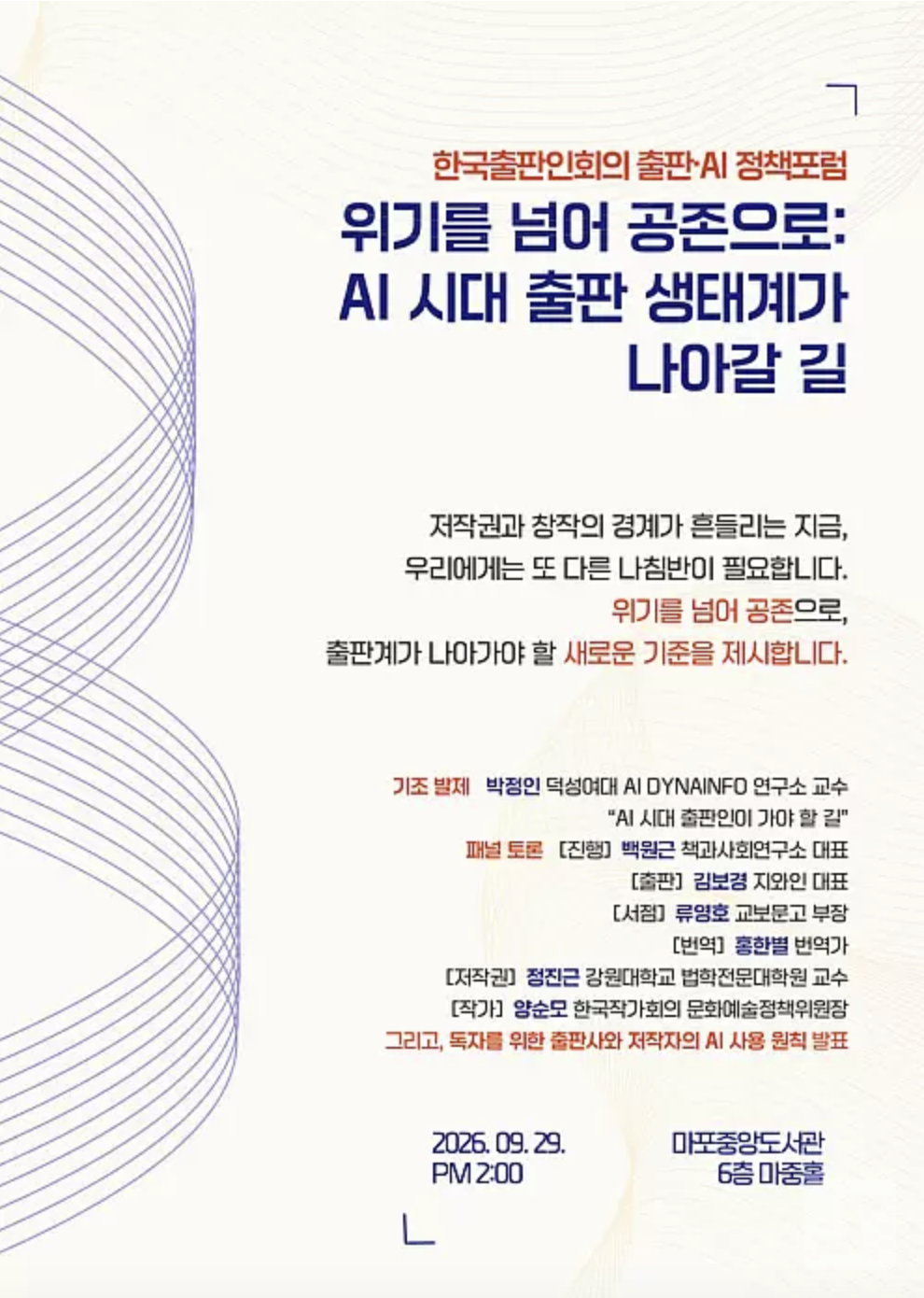
The Korean Publishers' Council held a 'Publishing-AI Policy Forum' on the 29th at the Mapo Central Library in Seoul under the theme 'Beyond Crisis to Coexistence: The Path Forward for the Publishing Ecosystem in the AI Era,' and proposed a 'Three-Tier AI Usage Label System' to this effect.
As the proliferation of generative artificial intelligence intensifies copyright and credibility disputes within the publishing market, South Korea's publishing industry has presented voluntary standards for explicitly indicating AI usage information in books. The aim is to provide readers with transparent creative information while protecting published works' copyrights from indiscriminate data learning by AI.
Three-Tier Classification from 'Human-Created Works' to 'AI-Generated Publications'
According to the plan unveiled on the day, publications are categorized into three tiers based on the degree of AI participation and control: ▲Tier 1 (Human-created works) ▲Tier 2 (AI-assisted works) ▲Tier 3 (AI-generated publications).
Tier 1 refers to cases where humans lead the creative process and AI is used assistively for simple proofreading, etc., with no separate marking on the cover. Tier 2 refers to works completed after humans conduct sufficient verification and revision based on AI-generated content. Conversely, Tier 3, where substantial human control or verification has not been performed, is labeled as 'publication' rather than 'work' based on the assessment that copyright recognition is difficult.
Park Jeong-in, professor at Dukseo Women's University's AI Dynalnfo Research Institute, who delivered the keynote address, explained that "the classification criterion is not the ratio of AI-generated sentences, but whether humans can review and take responsibility for the final product."
"Enhancing Negotiating Power Over Data"… Field Experts Recommend Forming Consortium
The publishing industry expects this labeling system to serve as an opportunity to strengthen negotiating power in future data usage negotiations with AI developers. Kim Bo-kyung, Policy Chair of the Korean Publishers' Council, evaluated that "by clarifying the legitimate rights of authors and publishers through Tier 1-2 labeling, we can establish grounds for data usage contracts."
Field-oriented proposals followed in the panel discussion. Translator Hong Han-byul stressed that "in a situation where AI is applied across all work tools, clarifying responsibility for results is more important than the usage itself," and Professor Jung Jin-geun of Kangwon National University's Law School recommended that "forming a consortium among publishers is necessary to smoothly receive compensation related to AI learning."
Publishing Organizations Jointly Declare 'AI Usage Principles'… Specifying Copyright and Compensation Calculation
Meanwhile, the Korean Publishers' Council, together with major publishing organizations including the Korean Writers' Association and the Korean Publishing Research Institute, declared 'AI Usage Principles for Publishers and Authors for Readers.' The declaration specifies ▲transparent disclosure of AI usage history ▲denial of authorship status for AI ▲authors' right to request fair compensation for AI learning, among others.
Loading comments…