'Economic Top Two' Exit Together… Lee Jae-myung Government's Economic Policy Shaken
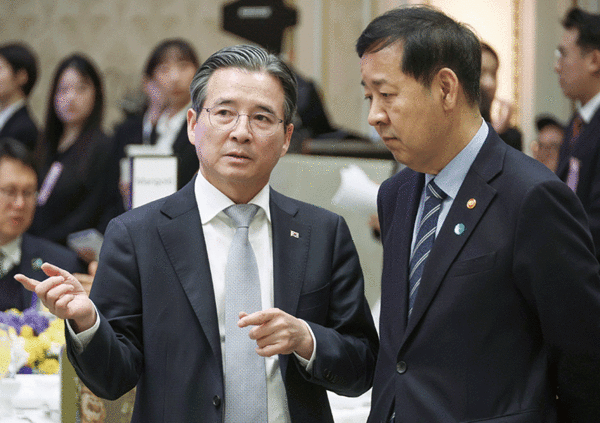
Kim Yong-beom, Cheong Wa Dae Policy Director, and Gu Yun-chul, Deputy Prime Minister for Economy and Minister of Finance and Economy, who have led the Lee Jae-myung government's economic policies, have stepped down consecutively. As the presidential approval rating has fallen to its lowest level since inauguration due to real estate and economic livelihood issues, the simultaneous replacement of the economic top two has also left a vacuum in the leadership of the '3 Major Mega Projects' worth 1,600 trillion won.
Cheong Wa Dae announced that Director Kim submitted his resignation to President Lee Jae-myung on the 31st of last month, and President Lee accepted his resignation on the 1st. Director Kim was appointed in the cabinet reshuffle on the 30th of last month but resigned after just one day. In the same reshuffle, Deputy Prime Minister Gu was included as a replacement target.
Director Kim served as the inaugural Policy Director of the Lee Jae-myung government, coordinating overall economic, financial, industrial, and real estate policies. Deputy Prime Minister Gu, as the inaugural Deputy Prime Minister for Economy, oversaw macro-economic, tax, and fiscal policies. The two have been called the 'economic top two' of the Lee Jae-myung government, both coming from orthodox economic bureaucracy backgrounds after serving as first and second vice ministers of the Ministry of Economy and Finance under the Moon Jae-in government.
Deputy Prime Minister Gu left the country to attend a Group of Twenty (G20) finance ministers and central bank governors meeting without being notified in advance of the cabinet reshuffle, and then Director Kim abruptly resigned, further compounding confusion surrounding the reshuffling of the economic team.
Analysis suggests that the recent sharp decline in national approval ratings influenced the 'economic top two's' joint departure. In Gallup's survey for the second week of August, President Lee's positive evaluation of job performance fell to 44%, the lowest since inauguration, while negative evaluation reached 46% for the first time exceeding positive evaluation. Among negative evaluation reasons, real estate policy was the highest at 30%, followed by economy, livelihood, and high exchange rates at 13%. In a late-August Realmeter survey, the approval rating also fell to 38.9%, dropping below 40% for the first time.
Within ruling circles, the rising apartment prices in the Seoul metropolitan area, prolonged high exchange rates and high interest rates, and financial market turmoil have been identified as major causes of the approval rating decline, and calls have been made to overhaul the economic policy line. The joint departure of the economic top two is being weighted as an accountable personnel reshuffle to address deteriorating public sentiment.
Director Kim faced criticism for shallow awareness of reality by describing high exchange rates, high interest rates, and high prices as the 'cost of success' and 'friction of a leap' amid semiconductor and stock market booms. Following the introduction of the 'national dividend' initiative to share semiconductor companies' profits with the public and single-stock leverage exchange-traded funds, financial market volatility sparked policy responsibility debates. Misaligned messages between the government and ruling party regarding real estate taxation and housing prices have also been cited as background for the resignation.
Deputy Prime Minister Gu's authority as the economic control tower was significantly weakened after the Ministry of Economy and Finance was separated into the Ministry of Finance and Economy and the Ministry of Strategy and Finance. As Cheong Wa Dae took the lead in U.S.-Korea tariff negotiations and industrial and real estate policies, Deputy Prime Minister Gu has been evaluated as failing to properly perform policy coordination functions.
The departure of the 'economic top two' has increased uncertainty in the government's 3 Major Mega Projects, which are central to the growth strategy. The government announced it would invest 1,600 trillion won over a long period in semiconductors, data centers, and physical artificial intelligence to create industrial hubs by region. Director Kim led corporate consultations and inter-ministry coordination, actively promoting the project by saying, "The scale of Korea's economy has changed."
However, just over two months after the announcement, the key planner and finance chief stepped down simultaneously. With the economic command post responsible for coordinating electricity, water, industrial sites, transportation networks, and tax and financial support and regulatory exceptions being entirely replaced at once, questions have been raised about policy continuity and implementation capability.
Although Ha Jun-kyung, Senior Secretary for Economic Growth, and Kim Jung-gwan, Minister of Industry, Trade and Energy, remain, the likelihood of immediate project suspension is small. However, since most of the 1,600 trillion won is not confirmed government budget but a long-term private investment plan, the project could be scaled down or delayed if special legislation, infrastructure budgeting, and final investment decisions by companies do not follow.
Cheong Wa Dae was reportedly not considering replacing Director Kim until recently. The reasons were that responsibility for policy failure could concentrate on Cheong Wa Dae and Director Kim's led investment negotiations with the U.S. had not been concluded. Nevertheless, Director Kim's abrupt resignation has strengthened interpretations that he assumed responsibility for the failure of economic policies and the decline in approval ratings.
The government announced a successor candidate for deputy prime minister for economy but did not disclose the successor to the policy director position or the overall system for the mega projects. Whether the joint departure of the economic top two will result in personnel renewal for approval rating recovery or lead to revision of first-term economic policies is expected to be revealed in subsequent personnel appointments, the 2027 budget proposal, and the process of handling the mega-district special law.
전시언 기자 yourside@news-s.kr