Constitutional Reform Debate Trapped by 'Lee's Re-election' — Power Structure and Fundamental Rights Sidelined
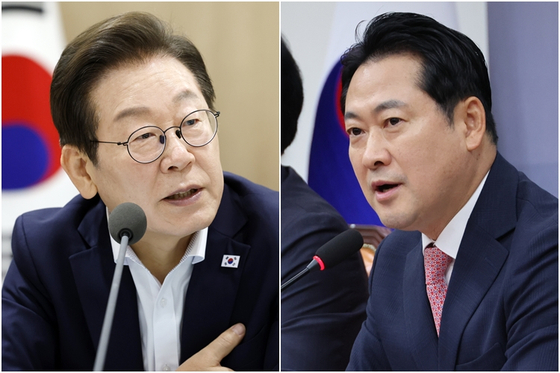
A constitutional reform debate dormant for nearly 40 years has become trapped by the question of "whether the incumbent president can serve one more term," failing to advance even a single step.
According to political circles on the 10th, President Lee Jae-myung stated on the 9th (local time) at a luncheon meeting with overseas Koreans in Paris, France: "My presidential term is clearly limited by the constitution."
It was his first direct comment on the recently emerged controversy over "Lee's re-election constitutional reform."
The Blue House quickly provided supporting fire.
Park Soo-hyun, the presidential spokesperson for public communication, said on MBC Radio on the 10th that when asked whether President Lee's remarks could be interpreted as meaning "I will not seek re-election," he responded: "It can be interpreted that way."
However, the People Power Party seized on the point that the president had not directly stated "I will not seek re-election."
People Power Party Chair Jang Dong-hyuk shot back at the party's emergency steering committee meeting: "No matter what the president says, we won't believe him, but he still hasn't said 'there will be no constitutional reform tricks for re-election' or 'I won't seek re-election.'"
He continued: "That was not an answer to a question about re-election, but rather a response to a question about 'why do you travel abroad so frequently?' — 'My presidential term is clearly limited by the constitution.' How long must we listen to the president's word games?"
Although the president mentioned "constitutional limits on his term" and the Blue House explained this to mean "he will not seek re-election," the opposition struck back by saying "he did not directly say he would not seek re-election," leaving the debate back where it started.
The problem is that as the political sphere concentrates its constitutional reform discussion on whether the incumbent president will seek re-election, the substantive agenda items of constitutional reform are being sidelined.
Surrounding the current constitution maintained for nearly 40 years since the 1987 constitutional reform, political circles have raised various needs for constitutional reform, including restructuring the power system starting with the five-year single presidential term, dispersing presidential authority, checks and balances between the National Assembly and the executive branch, strengthening local autonomy, and expanding fundamental rights reflecting changing social conditions.
President Lee's constitutional reform proposal is not limited to re-election alone.
On the 14th of last month, President Lee stated: "My pledge and consistent position has been to change the presidential term to a four-year term with re-election eligibility or consecutive terms to enable accountable politics through mid-term evaluations, and to reform the constitution by strengthening local self-governance and citizens' fundamental rights." He also raised the need for power dispersion by transferring some of the president's authority, such as appointment power, to the National Assembly.
A four-year presidential term with mid-term or consecutive re-eligibility is likewise a matter of power system restructuring that must address presidential accountability, policy continuity, and checks and balances — beyond any particular president's candidacy.
Public demand for constitutional reform is also not limited to "presidential re-election."
In a public perception survey released by the National Assembly Secretariat in February, 68.3% of respondents supported constitutional reform. Among those supporting reform, 70.4% cited "the need to respond to social changes and new issues" as their reason.
When asked about priority agenda items if phased constitutional reform were pursued, adding fundamental rights such as the right to life and right to safety topped the list at 35.1%, followed by restructuring the power system including presidential authority and term at 26.0%, and strengthening local autonomy and regional balanced development at 24.9%.
However, when looking solely at the presidential term system reform that has recently become controversial in political circles, public sentiment is more complex.
In a survey conducted by Realmeter on behalf of Energy Economics News from the 18th to 19th of last month targeting 1,017 adults aged 18 and over nationwide, support for a four-year presidential mid-term or consecutive re-eligibility constitutional reform was 46.0%, while opposition was 50.9%, with figures within the margin of error.
However, when asked about allowing the incumbent president to seek re-candidacy by applying constitutional reform on presidential terms retroactively, support was 34.7% while opposition was 61.7%, with opposition exceeding support by 27.0 percentage points.
This can be read as meaning that judgments on the system of "how to change the presidential system" and judgments on specific politicians "whether to allow this president to run again" do not necessarily align.
Nevertheless, recent political debate appears to concentrate on "whether constitutional reform would allow this president to run again" rather than "how to structure the constitution."
Some in political circles point out that both the ruling and opposition parties should step back from the "Lee re-election" controversy and engage in substantive constitutional reform discussions.
A political official said: "While controversy may arise over this president's re-election, the president can simply state clearly that he will not seek re-election, and Chair Jang can win an election if he is chosen by voters regardless of whether this president runs again. When both sides appear fixated on re-election disputes rather than comprehensive constitutional reform discussions, there is no choice but to question whether there is genuine willingness for constitutional reform."
The Realmeter survey was conducted using wireless 100% RDD automatic response methodology, with a response rate of 3.7% and a sample margin of error of ±3.1 percentage points at a 95% confidence level. For details, refer to the Central Election Opinion Poll Review Committee website.
전시언 취재편집부문 대표 yourside@suwonilbo.kr