Editorial The Football Association Confessed to Covering for the Referee—Now the Red Card Is the Association's
A referee in women's professional sports was heard telling a player, "You must be on your period." This testimony emerged from the WK League match between Suwon FC Women and Seoul City Hall at Suwon Sports Complex on the 28th. Ji So-yeon, who has represented Korean women's football for over 20 years, said she heard referee Bae Seon-young say over wireless communication: "She's been sensitive from the start. Must be on her period," referring to her. She disclosed the specific content of the remark, the situation at the time, and her protest. The match was suspended for four minutes, and the entire incident was captured in the league's live broadcast. If the testimony is true, this transcends the realm of disputed calls. It is explicit sexual harassment—the final authority on match proceedings using an official communication channel to make a player's body the subject of ridicule.
What followed was even more disheartening: the Korean Football Association's response. According to MBC reporting, the association's referee committee denied on the 29th: "It is true that the referee and assistant referee communicated, but they did not use the word 'period,' nor were they referring to player Ji So-yeon." In the same breath, they stated that "unnecessary comments and behavior are wrong conduct," and promised to provide refresher training to prevent recurrence. One must ask: if the problematic word was not used and no specific player was referenced, what exactly constitutes "unnecessary comments and behavior," and what specifically will be "prevented from recurring"? A denial of wrongdoing and a promise to correct misconduct cannot coexist in the same statement. This self-contradiction amounts to a confession by the association itself that something inappropriate did occur.
The process is more troubling. The association reached conclusions before even reviewing the match supervisor's report and the referee's report. Before an investigation even began, the institution preemptively declared the innocence of its own referee who was the subject of investigation. By the association's own logic, the player who testified to being victimized becomes someone who fabricated words she never heard. The first principle in handling sexual harassment cases is to verify victim statements through investigation—not for an institution to cover for its own people. This response is secondary victimization, making the victim cry twice. This is why criticism is escalating, saying that while the remarks themselves are problematic, the response is nothing short of a catastrophe.
There is another maddening aspect. The burden falls solely on the victim. Ji So-yeon cannot play in the match on the 2nd of next month due to accumulated cautions received during her protest. The player who objected to sexual harassment must sit out, while the referee identified as making the remark disappears behind "promises of training." It is hollow to speak of expanding the foundation and future of women's football while leaving this situation as is.
The path forward is not difficult. Wireless communication is an official channel heard by all members of the refereeing crew. The association and league must transparately disclose the facts by comparing the communication records from that time with the statements of the referees involved. Until the investigation concludes, the assignment of the referee in question should be suspended, and remedial procedures for Ji So-yeon's caution should also be reviewed. The association must respond faithfully to the official complaint that Suwon FC Women is preparing to file.
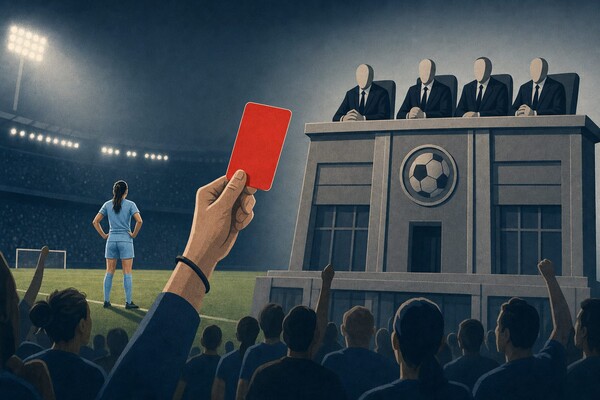
Korean women's football has come this far thanks to the dedication of its players. The moment this iconic player's testimony is buried in the face of institutional reputation, the trust of every player who steps on the field crumbles. What the association must protect is not the referee's face, but the dignity of sports. The player who protested did not deserve a red card that day. The red card now belongs to the association for attempting to conceal the truth.