Suwon Apartment Prices Rise Most in Gyeonggi Province... Interest Burden Surges
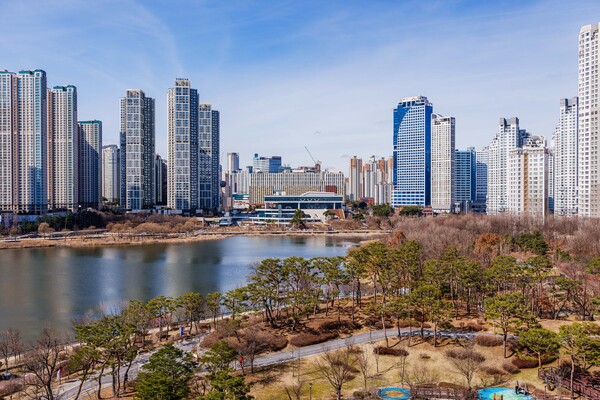
As Suwon apartment prices show the highest growth rates in Gyeonggi Province, the Bank of Korea has raised the base rate to 3%, intensifying the dual burden of rising apartment prices and increased loan interest payments.
According to the Bank of Korea and Korea Real Estate Board on the 27th, the Bank of Korea's monetary policy committee raised the base rate by 0.25 percentage points from 2.75% to 3.00% on the same day. Following the previous increase from 2.50% to 2.75% on the 16th of last month, this marks two consecutive rate hikes, raising the base rate by 0.50 percentage points in just over a month.
The Bank of Korea cited Seoul metropolitan real estate market conditions and household debt growth as one of the reasons for the rate increase.
In its monetary policy decision statement, the Bank of Korea stated that "Seoul metropolitan area housing prices have continued to show high appreciation, and household loans have also increased significantly." It further explained that from a financial stability perspective, there is a continued need to monitor the expansion of housing price appreciation and household debt growth in the Seoul metropolitan area.
Shin Hyun-song, governor of the Bank of Korea, also noted in a press briefing that while housing price appreciation in some Seoul areas has slowed somewhat, housing prices across the Seoul metropolitan area continue to show high appreciation. He explained that household loans from financial institutions have shown higher-than-usual growth rates, with both housing-related loans and other loans increasing.
Coincidentally, on the day the rate increase was announced, Suwon recorded the highest apartment price appreciation rate in Gyeonggi Province.
According to the Korea Real Estate Board's weekly apartment price trends for the fourth week of August, as of the 24th, apartment transaction prices in Gyeonggi Province rose 0.23% from the previous week, up from the previous week's 0.15% increase.
In particular, apartment transaction prices in Suwon's Yeongdeungpo-gu rose 0.75% in a single week, recording the highest appreciation rate in Gyeonggi Province. Gwangmyeong followed at 0.69%, Yongin's Suji-gu at 0.66%, Yongin's Giheung-gu at 0.63%, and Seongnam's Jungwon-gu at 0.60%. Suwon's Gwonseon-gu also rose 0.58%, recording the highest appreciation rate among Gyeonggi Province areas not designated as land transaction permit zones.
Analysts point out that expectations about semiconductor industry performance, lack of available properties, and anticipation of additional liquidity inflow from Samsung Electronics' internal housing loan implementation are influencing home price increases in southern Gyeonggi areas including Yeongdeungpo-gu.
Indeed, in Yeongdeungpo-gu, demand is concentrating on apartments with exclusive floor area of 85 square meters or less, which are subject to Samsung Electronics' internal housing loans. Comparing brokerage transactions in Yeongdeungpo-gu for three weeks before and after August 5th, when the floor area limit for internal loans was announced, exclusive 83-85 square meter transactions increased from 129 cases to 146 cases, up 13.2%. Meanwhile, exclusive over 85 square meters to 110 square meters transactions fell from 48 cases to 28 cases, down 41.7%.
As home prices surge and the base rate rises, the financial burden for owner-occupants borrowing to purchase homes is expected to grow.
Under the simple assumption that the base rate increase is fully reflected in loan rates, the 0.50 percentage point increase over two occasions last month and this month would result in an additional 2.5 million won in annual interest—approximately 208,000 won monthly—for a 500 million won loan.
For a 300 million won loan, additional annual interest of 1.5 million won would result, while a 700 million won loan would face 3.5 million won in additional annual interest. However, actual loan rates vary depending on COFIX, financial bond rates, additional and preferential rates, and whether rates are fixed or variable, so the base rate increase is not entirely reflected.
There is also a possibility the rate increases will not end here. The Bank of Korea indicated its policy is to determine the timing and pace of further increases while reviewing inflation, economic conditions, and financial stability.
Accordingly, Suwon's real estate market is expected to face contradictory factors of continued home price appreciation pressure and increased financial costs. In particular, for owner-occupants with high loan dependency, the double burden of increased housing purchase costs due to rising prices and expanded interest payments could take effect.
A real estate industry official said, "While demand accumulates through corporate loan support and bonuses, seller sentiment for sales has become reserved, potentially creating a flow where transactions decline while prices continue to rise. We expect various methods from financial institutions to manage total loan volumes while continuing transactions."
전시언 기자 yourside@news-s.kr