Reporter's Notebook Republic of Korea Education Through Former and Current Seoul Education Superintendents Jeong Geun-sik and Cho Hee-yeon
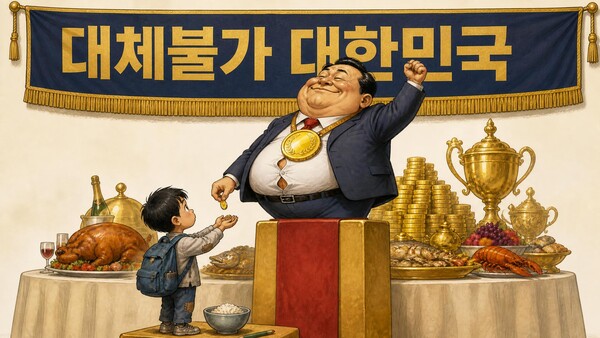
The government has named next year's budget "A Great Leap Forward to Irreplaceable Korea." The nation aims to create a country in semiconductors, artificial intelligence, and content that others cannot follow. Yet on a different page of the same budget, there is contradictory arithmetic. The government abolishes the education subsidy linkage to domestic tax revenue (20.79%) maintained for 55 years, capping next year's education subsidy at 78.9 trillion won. Had the linkage been maintained, it would have been around 100 trillion won, so the increase of approximately 20 trillion won goes not to education offices but to a newly created 162 trillion won Future Response Fund. The government emphasizes that "the total education budget does not decrease." That is true. However, the issue is not a reduction. The problem is that in a year when tax revenue balloons to record highs and everyone's share grows, only education's share is being frozen.
The government's rationale is 'OECD.' Since Korea's per-student education spending in elementary and secondary schools ranks at the top of OECD countries, it argues now is the time to adjust. Yesterday (the 2nd), when meeting Seoul Education Superintendent Jeong Geun-sik (Chair of the Korea Education Superintendent Council) at the Jeon Tae-il Memorial Hall in Seoul, he directly countered this logic. Why must education investment be scaled back to the 'OECD average' when every field from K-pop to semiconductors is leading the world?
He is right. The rise to the top in per-student spending is greatly influenced by the decline in children. As budget linked to tax revenue increased while the student population plummeted, reading the inflated numbers due to a shrinking denominator as evidence of 'over-investment' approaches optical illusion. In fact, measured by public education spending as a percentage of GDP, Korea is at the OECD average level. Structural reform in education to match changes in school-age population is certainly necessary. However, what should be prescribed to a patient needing structural reform is a surgical plan, not poison.
The grievance lies elsewhere. This boom was created by the entire nation together, and with increased taxes, all sectors' coffers grew equally. The education field was experiencing such relief for the first time in decades. There is a mountain of homework that had been postponed due to lack of funds: declining basic academic achievement, classroom transformation for the AI era, childcare gaps, collapsed teaching authority, overcrowded classrooms, and rural schools facing extinction. Just as there was finally some room to tackle these overdue tasks, the government says it will take that entire share to the fund's coffers. With so many education problems to solve, is the request to share in the increased taxes together really so unreasonable?
By analogy with a household: parents strike it rich and plan an overseas trip, while telling their child to study with workbooks instead of tablets, boasting, "I'll buy you one really good problem set." When a family's circumstances improve, good parenting starts with caring for the child's education. Seeing a government that freezes children's share while the national coffers swell to record levels, one cannot help but ask whether this is truly acting as a parent.
If we trace back, it is education that caused the decline in students. Was it that people couldn't afford to feed children? The answer that has emerged for decades is that families dare not raise children for fear of education costs. The failure of Korea's education has not only produced low birth rates. On the foundation of education that failed to teach how to mediate conflict and recognize difference, extreme left-right confrontation, gender conflict, and all manner of social discord have grown. The result has been a birth rate plummeting like a bird without wings, and only now has the plunge stopped and a thread of recovery been grasped. This is our current situation.
Yet at this juncture, the government proposes cutting education budgets. This time, we must not break the wings of the future generation that has barely stopped falling. Cuts pushed through without thorough planning and verification will not only fail to aid recovery but will scatter ashes upon it.
The 'reinvestment' packaging also warrants scrutiny. Of the 162.3 trillion won fund, actual investment in four priority sectors is 45.4 trillion won, while 104 trillion won accumulates in reserves called 'surplus funds.' The education and talent account stands at 10.1 trillion won, the smallest among the four accounts. It amounts to taking 20 trillion won from education to put 10 trillion won into education and talent. This is difficult to call reinvestment.
The process is more painful. While changing a system over half a century old, there was not a single formal consultation with education superintendents and education organizations nationwide. Superintendent Jeong even publicly stated last month that "we need to explain and hear opinions, but the procedure was very negligent." Three hundred fifty-three education and civic organizations demanded it be scrapped, but the government responded through State Council resolution, and the bill goes to the National Assembly on the 3rd.
Yesterday at the Jeon Tae-il Memorial Hall, Cho Hee-yeon, the former education superintendent who served three terms—the first in constitutional history—launched an education civic organization called the 'Court of Coexistence' under the banner of 'coexistence.' This reflects awareness of a problem: a culture of coexistence that mediates conflict and recognizes difference has disappeared from our society, leaving only confrontation and confrontational structures, and the foundation of this failure lies in education. Given how serious the conflict and confrontation in our society appeared to him, why else would he name the organization 'Court of Coexistence'? On one hand, citizens are creating a court to repair education's failure, while on the other, the government is stealing money meant for children's education under the pretext of 'exceeding OECD average,' citing the rise in per-student education spending as budget linked to tax revenue increased while students plummeted.
If reform is necessary, the first step should be to create a minimum process of discussion. The ball is now in the National Assembly's court. What the National Assembly must ask is not the scale of the fund, but whether a nation targeting averages can become irreplaceable. "Invest at the average level, deliver irreplaceable results." Let us hope this statement does not become the explanation for the Republic of Korea's new budget proposal.