Kim Seung-won's Nomination as Justice Minister Candidate Will Suwon Produce Its First Active Minister Born and Raised There?
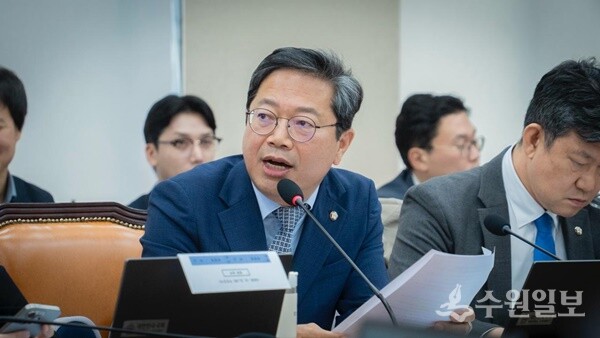
◇ First Active Assemblyman Born and Raised in Suwon to Assume Cabinet Position
An active National Assemblyman born in Suwon and representing Suwon as his district is on the verge of assuming a ministerial position for the first time. It is Kim Seung-won, a Democratic Party member representing Suwon-gap, who was nominated as Justice Minister candidate just six years after first earning his parliamentary seat in 2020.
President Lee Jae-myung nominated Assemblyman Kim on the 30th as the successor to former Justice Minister Jung Sung-ho. Once confirmed through National Assembly hearings and appointed, he will become the first active district representative born and raised in Suwon to assume a cabinet position.
It is not the case that Suwon has been without ministers in its political history.
Lee Byung-hee, one of the representative politicians of Suwon, was elected to the National Assembly seven times from Suwon and served as minister without portfolio under the Park Chung-hee administration. Former National Assembly Speaker Kim Jin-pyo served as deputy prime minister for economy and finance minister under the Roh Moo-hyun administration, was elected to the National Assembly from Yeongtong, Suwon in 2004, and assumed office as deputy prime minister for education and minister of education and human resources the following year while serving as an active assemblyman.
Candidate Kim's case differs in his political development path.
Born in Suwon and having attended elementary, middle, and high school there, he later served as a judge at the Suwon District Court after becoming a legal professional. When entering politics, he chose Jangan-gu, where he was born and raised, as his district. It is a path where a person born and raised in a region passes through the legal profession and the National Assembly to become a department head of the central government.
◇ From Suwon District Court Judge to Suwon-gap Assemblyman
Candidate Kim was born in Jangan-gu, Suwon in 1969 and graduated from Pajang Elementary School, Suwon North Middle School, and Suseong High School. After graduating from Seoul National University's Public Law Department, he passed the 38th Bar Examination and completed the 28th session of the Judicial Research and Training Institute.
After serving as a military legal officer, he began his judicial career at the Jeonju District Court in 2002 and later served as a judge at the Suwon District Court. After shedding his robes in 2009, he worked as an attorney.
His formal connection with politics began during the Moon Jae-in administration. In 2018, he was recruited as an administrator at the Presidential Secretariat's Political Affairs Office and worked at the Blue House, later moving to the National Assembly.
He passed the Democratic Party's primary for the Suwon-gap candidacy in 2020 and earned his first parliamentary seat in the 21st general election. He made a new start as a politician in Jangan-gu, Suwon, where he was born and spent his school years.
He won reelection in the 22nd general election in 2024.
After entering the National Assembly, he developed his political identity based on the expertise he built as a legal professional.
In the 21st National Assembly, he participated in "Cheoreumhoe," a group of Democratic Party members advocating for reform legislation including prosecution reform. During the period when President Lee Jae-myung served as Democratic Party chairman, he held the position of party legal committee chairman and participated in activities of the Committee for Countermeasures Against Prosecutorial Dictatorship and Political Oppression, building his presence in the party's legal and judicial fields.
His political activity also expanded beyond Suwon-gap to encompass Gyeonggi Province as a whole.
In the 2024 Democratic Party Gyeonggi Provincial Committee Chairperson election, he was elected with 57.59% of the vote. A second-term assemblyman from Suwon rose to lead the party organization of Gyeonggi Province, the nation's largest metropolitan government. In his acceptance speech at the time, he clearly stated his intention to lead prosecution reform.
◇ From 'Prosecution Reform Legislator' to Justice Minister
The decisive arena for Candidate Kim's rise to Justice Minister candidate was the 22nd National Assembly's Law and Judiciary Committee.
As Democratic Party floor leader and chair of the first legislative subcommittee of the Law and Judiciary Committee, he led the legislative work on prosecution reform and criminal justice system reform pursued by the ruling party.
In particular, his role stood out in the subsequent legislative process of reflecting the framework for abolishing the Prosecution Service and transitioning to an appellate prosecution system into actual criminal proceedings.
A prime example is the abolition of prosecutorial supplementary investigation authority.
Candidate Kim took the lead in processing amendments to the Criminal Procedure Act that would abolish prosecutors' direct and supplementary investigative authority. Instead of prosecutors directly conducting supplementary investigations into police cases, prosecutors would request police to conduct supplementary investigations, effectively separating investigation from prosecution and embodying a new criminal justice system in law.
When the bill was brought to the National Assembly plenary on July 30, Candidate Kim, as the Democratic Party floor leader of the Law and Judiciary Committee, personally delivered the explanatory remarks for the proposal.
A first-term assemblyman who advocated for prosecution reform became, upon reelection, an actual legislative drafter serving as floor leader of the Law and Judiciary Committee, and now he moves to the position of Justice Minister candidate tasked with implementing the systems he dealt with in the National Assembly.
The presidential office also cited this experience as the background for the nomination. Presidential Chief of Staff Kang Hoon-sik stated that Candidate Kim understands the purpose of the criminal justice system reform in depth and is expected to quickly establish the new criminal procedure system.
Before Candidate Kim lies an immediate test.
On October 2, the Prosecution Service will be abolished and the Appellate Prosecution Service will launch. While former Minister Jung Seong-ho established the broad framework of criminal justice system reform involving the abolition of the Prosecution Service and launch of the Appellate Prosecution Service, his successor must accomplish the task of anchoring this new system in actual practice.
He must not only reorganize the organization and personnel system but also address concerns about investigative delays and gaps following the abolition of supplementary investigative authority, and issues regarding victim rights remedies.
The role transforms from 'prosecution reform legislator' to 'prosecution reform executor.'
◇ After Lee Byung-hee and Kim Jin-pyo…Suwon Politics Returns to National Stage
Local political circles are watching Candidate Kim's nomination not merely for individual political advancement.
Suwon is the nation's largest-scale basic local government with over 1.2 million residents and is the seat of Gyeonggi Province. It has five National Assembly district constituencies. Yet there has been continued assessment that the presence of Suwon's political circle in the central government and central politics remains relatively small compared to the city's scale.
There were times in the past when Suwon politics demonstrated its presence on the national stage.
Former Assemblyman Lee Byung-hee achieved seven consecutive elections from Suwon during the 1960s to 1990s, exercised influence in central politics, and even served as minister without portfolio. Former Speaker Kim Jin-pyo served as deputy prime ministers for economy and education under the Roh Moo-hyun administration, was elected five consecutive times from Suwon, and ultimately rose to become National Assembly Speaker, the head of the legislative branch.
However, more than 20 years passed without any active district representative from Suwon assuming a cabinet position since former Speaker Kim's appointment as Deputy Prime Minister for Education in 2005 while serving as an active assemblyman.
If Candidate Kim takes office as minister, he will fill that gap. Particularly, there is great anticipation from the local political circle in that a new precedent will be created with an active representative born and raised in Suwon assuming a cabinet position.
That expectation is intertwined with local issues.
Major Suwon agendas such as the relocation of Suwon Military Airport, the pursuit of an economic free zone, and the expansion of metropolitan transportation networks are essential to require consultation and support from the central government. While the Justice Minister does not directly handle individual regional projects, the expectation is that an active representative with Suwon as his political base participating in state affairs as a cabinet member can become another conduit connecting the region and the central government.
A deeper significance lies in 'connection.'
A political development path has been created where a person grown in the region becomes a district representative, serves as Gyeonggi Provincial Committee Chairperson and Law and Judiciary Committee floor leader, and then rises to cabinet membership.
This is why there is anticipation that Candidate Kim's assumption of office could transcend the success of one politician and lead to a new pathway for politicians grown in Suwon to advance to the national stage.
A local political figure stated, "There has been steady discussion about the need for someone from Suwon to play a role at the center of central politics after former Assemblyman Lee Byung-hee and former Speaker Kim Jin-pyo. Particularly, the nomination of an active representative born and raised in Suwon as a cabinet candidate is significant. We hope this appointment becomes an opportunity not limited to one politician's political advancement but opens a new path for politicians grown in Suwon to extend to the national stage."
전시언 기자 yourside@news-s.kr