Law or Coupang? ③ Consumer Legal Rights Disappear on Platforms
When a problem arises with a product ordered and paid for on Coupang, how much can consumers resolve through Coupang? When we traced a children's product subject to a government-mandated recall, tracking the buyer and notifying them of the recall occurred within Coupang, but after that it was "up to the consumer." The statutory period for contract withdrawal set by law differed from Coupang's own return standards, and instead of receiving refunds through the existing payment method, consumers had to provide bank account information to the seller. News S examines through one recall case how consumer rights guaranteed by e-commerce law actually function within a major platform's system, why money and personal information move outside the platform in the subsequent process, and how far current law defines platform responsibility, over three installments. Editor's note
While e-commerce law guarantees consumer rights such as contract withdrawal and refunds, the procedures for exercising these rights are designed by online commerce platforms themselves, which means that rights guaranteed by law may not function within the platform.
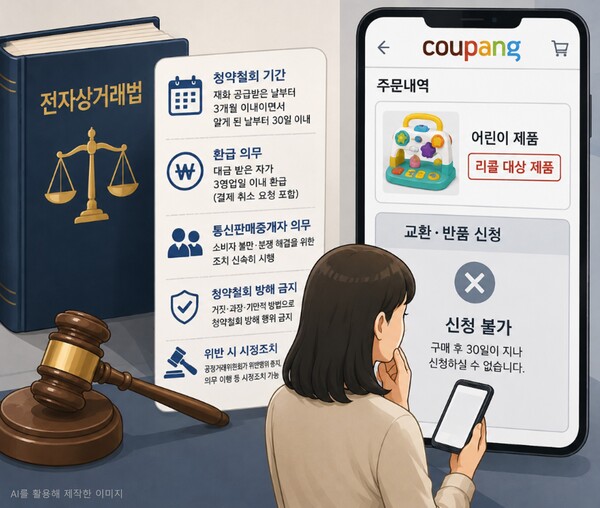
According to the Fair Trade Commission on the 23rd, Article 17, Paragraph 3 of the e-commerce law stipulates that when the contents of goods differ from advertised or contracted details, consumers can request contract withdrawal within three months from the date of receiving the goods and within 30 days from when they became aware of or could have become aware of the problem.
In this recall case, there was a discrepancy between this statutory period and the platform's (communication sales broker's) own standards.
The buyer had not yet passed three months since receiving the product, and had not passed 30 days since learning of the safety standard non-compliance. However, on Coupang, exchange and refund requests for the order were blocked because more than 30 days had passed since purchase.
While the statutory period for contract withdrawal remained under law, the platform's application pathway to exercise it was closed first.
Refund obligations following contract withdrawal and the platform's consumer protection duties are also defined in law.
Article 18 of the e-commerce law stipulates refund obligations following contract withdrawal and includes in "communication sales operators" those who "received payment for goods from consumers or those who concluded a communication sales contract with consumers." For credit card payments and similar cases, it requires requesting the payment provider to suspend or cancel the charge.
However, there is also an interpretation that Articles 17 and 18 may not apply to platforms.
Article 20, Paragraph 3 requires communication sales brokers to promptly take necessary measures including identifying causes and damages to resolve consumer complaints or disputes arising from cyber mall use.
Acts that obstruct consumer contract withdrawal are also prohibited. Article 21 prohibits communicating false or exaggerated facts or obstructing contract withdrawal or termination through deceptive means, and Article 32 allows the Fair Trade Commission to order corrective measures including cessation of violations, fulfillment of obligations, and consumer damage prevention and remedies when obligations specified in the law are violated or not fulfilled.
From contract withdrawal to refunds, to dispute resolution by communication sales brokers and corrective measures for legal violations, regulations are already in place to protect consumers.
The issue is whether rights written in law actually function within the platform's system.
In online transactions, what consumers encounter is not legal provisions but exchange and refund buttons displayed in order history. Even when the statutory period for contract withdrawal remains, if the request is impossible on the platform, consumers must contact customer service separately or seek alternative measures through relevant authorities.
The law grants consumers rights, but in reality, platforms are designing the entry points and procedures for actually exercising those rights.
Current law allows the FTC to take corrective measures when obligation violations or obstruction of contract withdrawal is confirmed.
However, whether the platform's exchange and refund system itself reflects the statutory grounds and periods for contract withdrawal before consumers raise issues is a separate matter.
Particularly when platforms are aware of product problems and can identify affected buyers like in government recalls, there are calls to distinguish such cases from general return standards and reflect pathways for exercising legal rights in the system.
An FTC official said regarding this case, "Government recalls appear to meet the requirements for contract withdrawal, but various situations may exist regarding payment methods and fund flows, so we need to verify the exact circumstances," adding "We will take action if legal violations are confirmed."