"Solving Semiconductor Power Shortage on Expressways"...Gyeonggi Research Institute's Innovative Proposal
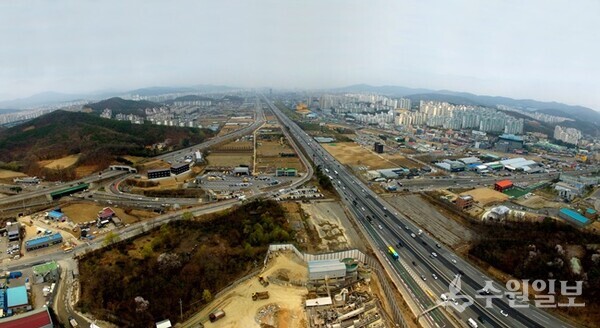
Semiconductors run on electricity. How to secure power is the key issue. As the world's largest semiconductor cluster in Yongin and artificial intelligence (AI) data centers begin in earnest, Gyeonggi Province's electricity demand is expected to skyrocket. By 2050, Gyeonggi Province's annual electricity consumption is projected to reach approximately 285,000 GWh, double the current level.
However, securing "power roads (transmission lines)" to deliver produced electricity to where it is needed has emerged as a national challenge. Typically, constructing new massive transmission towers and power lines takes more than 10 years just for site selection due to local opposition and land compensation issues. In response, the Gyeonggi Research Institute has garnered attention by announcing a vision for the "Gyeonggi Energy Expressway" that would solve the power shortage decisively by utilizing 840km of expressway infrastructure in the province.
According to a research report released by the Gyeonggi Research Institute titled "Finding the Answer to Power Shortage in the Semiconductor Era on Expressways," expressways are an exceptional breakthrough alternative because they are already land secured by the nation, allowing underground power transmission lines to be laid directly without private land compensation or community conflicts.
The shortest route to bring approximately 3GW-scale large-scale solar power to be produced in West Coast tidal flats (Sihwa, Hwawon, and Pyeongtaek Lake) to southern Gyeonggi, where the semiconductor industry is concentrated, is the West Coast and Pyeongtaek-Siheung Expressway. By adopting this method, the construction period for transmission lines, which previously took an average of 13 years, can be dramatically shortened to 5-7 years, perfectly solving the power supply timing issue for the Yongin semiconductor factory that will operate in stages starting in 2029.
Expressways serve not only as roads for electricity transmission but also as excellent "zero-emission power plants" in themselves. By utilizing idle areas of approximately 840km, including embankments, fill slopes, and sound barriers along expressways in the province, a 588MW-scale solar facility can be installed. The electricity generated annually from here alone amounts to 773GWh, an enormous amount that an entire small- to medium-sized city can use.
Additionally, a strategy of installing 4MW-class large-capacity energy storage systems (ESS) at rest areas and interchanges along expressways is added. By storing excess electricity produced by solar power during the day and releasing it at night when power consumption is high, the limit of solar power that can be accepted by existing distribution lines expands significantly from 14MW to 18MW, providing immediate relief even before a large-scale transmission network is completed.
Particularly, this vision is designed as a "win-win model" that shares development profits with local residents and communities. It will be pursued with resident participation, where residents and local communities participate as investors for 4% or more of project costs, allowing money earned from solar power generation to be returned to residents as regular dividends. When conducted with resident participation, solar power separation distance regulations are legally waived, and residents who previously opposed power plants entering their areas transform into shareholders and stakeholders of the project, achieving a threefold effect of site acquisition, profit generation, and community acceptance.
The Gyeonggi Research Institute proposed establishing a three-party cooperation system involving Gyeonggi Province, Korea Expressway Corporation, and Korea Electric Power Corporation for successful implementation. Gyeonggi Province will oversee overall policy and reflect plans in the national power grid, Korea Expressway Corporation will provide road sites and pipelines to generate revenue from idle assets, and Korea Electric Power Corporation will resolve transmission bottlenecks and subsequently acquire the completed power network. The institute ordered that Phase 1 prioritize the "Seohwasung Aggregation Feeder Network" linking West Coast tidal flat solar as a pilot project, then expand it to southern Gyeonggi, including the Gyeongbu and Yeongdong Expressways, and nationwide expressways.
Kim Jeom-san, Senior Research Fellow at the Gyeonggi Research Institute, said, "The success of the semiconductor and AI industries depends on supplying necessary power in a timely and environmentally friendly manner," and "Building an energy network using expressways is a realistic and innovative solution that can overcome the massive barriers of community conflicts and land compensation."