People Power Party to Evaluate Incumbent Lawmakers as Party Members...Jang Dong-hyuk's Model of 'Member-Centric Party' Institutionalized
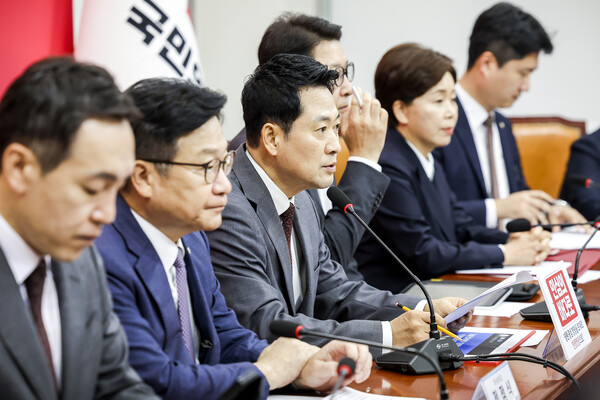
[News S = Reporter Jeon Si-eon] The People Power Party decided to conduct local member evaluations of existing party chapter council chairs, including incumbent National Assembly members, and to reflect 50% of these evaluations in regular party discipline audits.
While a full direct election system for party chapter council chairs was put on hold, the inclusion of incumbent lawmakers as subjects of member evaluation is seen as a substantial realization of Chairman Jang Dong-hyuk's vision of a 'member-centric party.'
According to political circles on the 31st, People Power Party Secretary-General Jung Hee-yong met with reporters after a supreme council meeting at the National Assembly and said, "We reviewed fully implementing a direct election system for party chapter council chair elections, but decided to introduce it gradually and in phases, reflecting recent opinions from the legislative caucus and other party members."
Accordingly, this year's regular party chapter council chair election will proceed through the existing party chapter operating committee method. The People Power Party will complete the election by the 15th of next month and decided to retain the current party chapter chairs until the procedures are finished to prevent organizational gaps ahead of Chuseok.
Party chapters headed by incumbent National Assembly members will elect chairs through the same method. This is a compromise that respects the local voters' choice and the incumbent legislator's representativeness confirmed in the general election, while separately verifying their activities as party chapter chair and organizational management performance through member evaluation.
Secretary-General Jung said, "We plan to conduct party discipline audits excluding troubled party chapters and make it mandatory to reflect 50% of party members' evaluations of party chapter chairs," and "we will deduct points for those who committed violations in party discipline audits."
Party chapters ranked in the lower tier following party discipline audit results are selected as candidates for chair replacement. Subsequently, the Organization Strengthening Special Committee will examine the candidates' qualifications, and if there are two or more qualified applicants, the plan is to elect a new chair through direct election by party members.
However, existing chairs will not be automatically replaced based solely on lower ratings. According to current regulations, actual replacement requires procedures such as hearing the opinions of the relevant provincial party chair and secretary-general and having the supreme council resolve the chair's resignation.
Chairman Jang initially pursued a plan to have all existing party chapter chairs resign en masse and then be reelected through direct member election. However, with continued opposition from incumbent lawmakers centered around the legislative caucus, the plan was adjusted to a two-phase method applying direct elections starting with troubled party chapters and lower-ranked party chapters in discipline audits.
While taking a step back from full direct elections, the party maintained the core aim of expanding member authority by fixing member evaluation at half of the party discipline audit score and having members participate in electing new chairs of lower-ranked party chapters.
Specific questions for member evaluation, survey targets, minimum response rates, and the remaining 50% of evaluation items and criteria for selecting lower-ranked chapters have not yet been disclosed. How to weight assessment of legislative struggles and regional activity achievements is also expected to be a point of contention in future detailed standards.
Park Sung-hun, chief spokesman of the People Power Party, said, "Party members' complaints about party chapter chairs who don't work in their regions, particularly opposition legislators who don't fight against the ruling party, are expected to ease somewhat with the implementation of this plan," and "we believe it will have a significant effect in improving the party's character into a fighting opposition party."
전시언 기자 yourside@news-s.kr