Residual Pesticide Levels in Distributed Tropical Fruits Meet Safety Standards
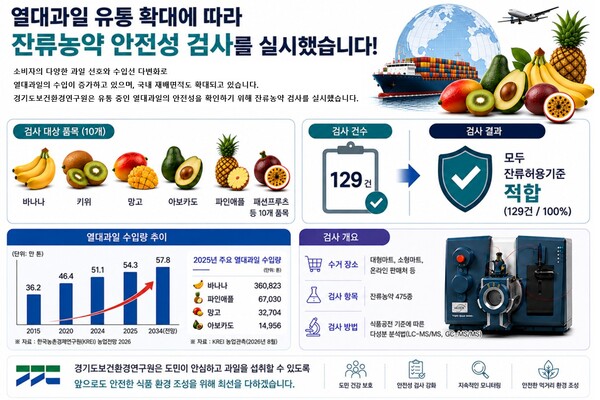
The Gyeonggi Province Institute of Health and Environment conducted residual pesticide tests on 129 samples across 10 tropical fruit items distributed through large and small marts and online retailers during July, with all samples found to comply with residual pesticide tolerance standards.
The collected items consisted of △bananas (26 samples) △kiwis (26 samples) △mangoes (20 samples) △avocados (17 samples) △pineapples (12 samples) △dragon fruit (9 samples) △mangosteens (6 samples) △papayas (5 samples) △coconuts (4 samples) △passion fruit (4 samples), totaling 10 items and 129 samples. The fruits comprised imported tropical fruits (118 samples) from various countries including the Philippines, Thailand, New Zealand, Vietnam, and Peru, as well as domestic products (11 samples).
Tests for 475 types of residual pesticides detected residual pesticides such as carbendazim and thiabendazole in some samples; however, all were confirmed to be at safe levels within domestic residual pesticide tolerance standards.
Do Young-suk, head of the Agricultural and Fishery Products Inspection Division at the Gyeonggi Province Institute of Health and Environment, stated, "Along with increasing consumption of tropical fruits in recent times, subtropical fruit cultivation is expanding domestically due to climate change," and added, "We will continuously strengthen residual pesticide safety management for both imported and domestic tropical fruits to create a food environment where residents can consume with confidence."