Suwon Stuck in Place for 9 Years…Gwangju Military Airport Relocation 'Fast-Tracked'
Mangun-myeon area in Muan County, South Jeolla Province has been selected as the relocation site for Gwangju Military Airport. This comes just four months after being designated as a provisional relocation candidate. In contrast, the Suwon Military Airport relocation project has remained at the same stage for nine years since its provisional relocation candidate was selected in 2017.
The Defense Ministry's Military Airport Relocation Site Selection Committee selected the Mangun-myeon area in Muan County as the relocation site for Gwangju Military Airport on the 28th. The Muan County Governor expressed conditional agreement, thereby meeting the social consensus requirement necessary for selecting the relocation site.
The Gwangju Military Airport relocation project gained momentum when a six-party consultative body comprising Gwangju City, South Jeolla Province, Muan County, the Ministry of Strategy and Finance, the Defense Ministry, and the Ministry of Land, Infrastructure and Transport was formed under the Presidential Office's leadership in December last year. The decision to locate the Gwangju Military Airport site as the Honam region semiconductor cluster also became a driving force for project promotion.
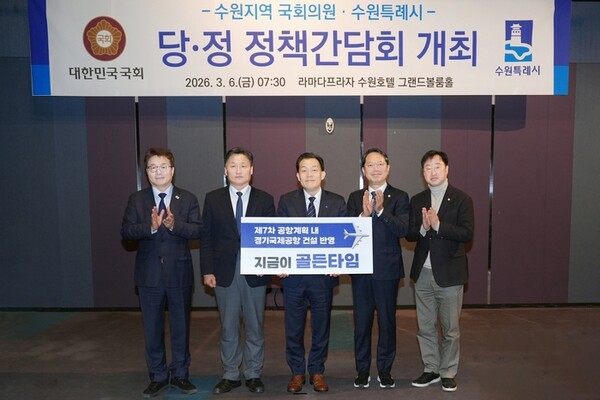
The Suwon Military Airport relocation project started earlier than Gwangju.
Suwon City submitted a request for military airport relocation to the Defense Ministry in March 2014. This was about seven months earlier than Gwangju City's submission of a similar request in October the same year.
The Defense Ministry approved Suwon Military Airport relocation in 2015 and designated the Hwaseong Hwawong district as the provisional relocation candidate site in February 2017.
However, Hwaseong City requested withdrawal of the candidate site designation and a review of the project from the ground up, which prevented subsequent procedures such as relocation candidate site selection, support plan establishment, resident voting, and application submission from proceeding.
The Mangun-myeon area in Muan County was elevated to a relocation site through conditional agreement by the Muan County Governor, which was contingent on regional support, whereas Hwaseong City opposes the Hwawong district relocation. The different positions of the local government heads targeted for relocation created a gap in the progress stages of the two projects.
Differences also emerged in the status and driving force of government coordination bodies.
In the case of Gwangju Military Airport, President Lee Jae-myung publicly ordered problem resolution and the Presidential Office led the six-party consultations, marking a turning point. The consultative body coordinated support for the relocation area, integration of private airports, and plans for creating national industrial complexes, drawing conditional agreement from the Muan County Governor.
A military airport relocation task force within the Presidential Security Service also operated for the Suwon Military Airport relocation project. However, it did not reach the level where the President directly ordered resolution or where the Presidential Office led negotiations between stakeholders. The task force also failed to devise support measures and adjustment plans to resolve Hwaseong City's opposition.
Plans for Suwon Military Airport relocation and development of the former site have been pursued since the 2000s.
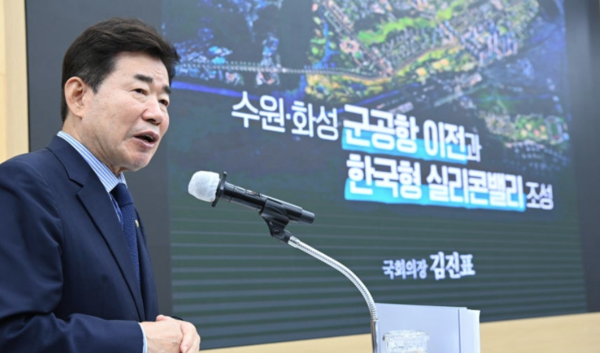
In 2007, former National Assembly member Kim Jin-pyo proposed creating an advanced information technology complex on 8.9 million square meters of land to be secured through the relocation of Suwon Air Base. The concept was to connect surrounding digital and bio-industry hubs and create a Korean version of Silicon Valley with a scale of approximately 20 million square meters.
To this end, Kim introduced the "Special Act on the Relocation and Support of Military Airports," which was enacted in 2013. Subsequently, Yeom Tae-young, then Suwon Mayor, and Democratic Party members from the region made Suwon Military Airport relocation a key campaign pledge in every election. However, since the provisional relocation candidate was selected in 2017, the project has not progressed to the next stage of selecting the relocation site.
Meanwhile, Gwangju has seen the military airport relocation treated as a prerequisite for national advanced industry policy, as a national project to create a Honam region semiconductor cluster on the vacated military airport site has been confirmed.
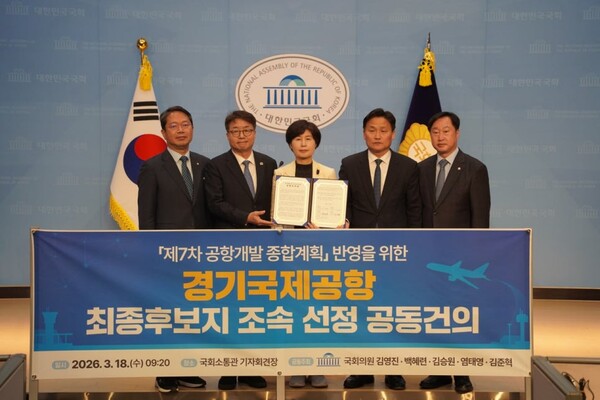
The 'Suwon Military Airport Relocation and Gyeonggi Integrated International Airport Promotion Citizens' Council' is conducting an online petition campaign demanding prompt pursuit of military airport relocation and construction of a southern Gyeonggi international airport.
A council representative said regarding the selection of the Gwangju Military Airport relocation site, "I believe the President's will is important," and "If a presidential town hall meeting is held in southern Gyeonggi, we plan to attend and strongly request Suwon Military Airport relocation."
Suwon City takes the position that military airport relocation should be pursued as a national strategic project rather than an inter-local government issue.
Like Gwangju, the city's policy is to request that the Presidential Office and related government agencies directly participate in mediating inter-regional conflicts and specifying support measures for the relocation area.
A Suwon City official said, "We evaluate it positively that a relocation site was ultimately selected despite opposition from the area corresponding to the provisional relocation candidate," and "We plan to request the government to establish a state-led consultative body for the Suwon Military Airport case as well to promote the project."
전시언 기자 yourside@news-s.kr