"Big trouble" — Choo Mi-ae requests 244.6 billion won in additional national budget from Lee Gwang-jae
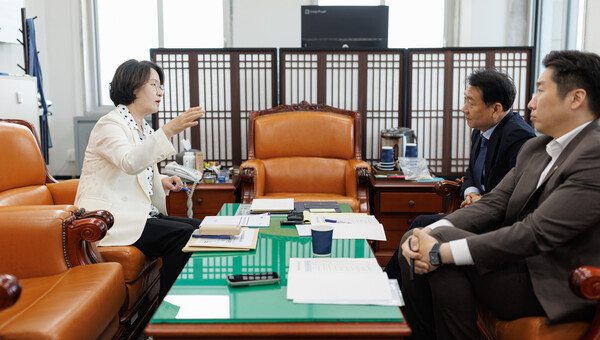
On the 9th, Gyeonggi Province Governor Choo Mi-ae met with National Assembly Budget Committee Chairman Lee Gwang-jae to explain 10 major national funding projects, including support for labor inspector personnel expenses, and requested an additional 244.6 billion won in national budget allocation.
Governor Choo's visit to the National Assembly marks her second effort to secure national funding, following her meeting with Planning and Budget Minister Park Hong-geun in July. The visit was intended to explain the necessity of Gyeonggi Province's key projects and request cooperation in increasing national budget allocation and reflecting these projects ahead of National Assembly deliberations on the government budget for the upcoming fiscal year.
When Governor Choo Mi-ae met with Budget Committee Chairman Lee Gwang-jae, she opened with the greeting "Big trouble," and immediately laid out a list of 10 major national funding projects for Gyeonggi Province in 2027, persuading him point by point about the need for support.
Governor Choo first raised the issue of support for labor inspector personnel expenses. She said, "The labor inspector position is a project whose necessity was emphasized by President Lee Jae-myung during his tenure as Gyeonggi Province governor, making Gyeonggi Province a pilot region. We are recruiting 170 inspectors to deploy them to work sites in the first half of next year by the end of this year, but we have no budget for personnel expenses. Labor inspections are a state-delegated task. Personnel expense support is necessary. While they say we should use the fines collected at worksites for personnel expenses, that is unstable. We need 20.5 billion won in national funding."
Governor Choo secondly requested personnel expense support for delinquent collection activities. She said, "Employees are hired on temporary contracts and receive no personnel expense support whatsoever. We are asking for at least 50% of the costs to be covered by national funding. We are not simply collecting delinquent taxes—we simultaneously conduct livelihood-type investigations, thereby carrying out the government's task of strengthening the social safety net. This is the basis for the 50% national funding support," she emphasized.
Third, she mentioned the Northern Gyeonggi Metropolitan Railroad construction project (Dobongsan-Okjeong, Line 7 extension), a long-standing project in northern Gyeonggi Province, saying, "The construction costs have been set too low, leaving compensation and tunnel lining costs inadequately reflected. An additional 17.8 billion won is essential for opening within the promised timeline."
Among the 10 projects Governor Choo proposed that day, three items totaling 89 billion won—labor inspector personnel expense support (20.5 billion won), local tax and non-tax revenue delinquent collection support project (4.8 billion won), and Nuri Program childcare subsidy support project (63.7 billion won)—are not reflected in the 2027 government budget proposal. The remaining seven projects have a total of 388 billion won reflected in the government budget, with Gyeonggi Province requesting an increase of 155.6 billion won.
Governor Choo explained that after firefighting positions were converted to national positions, Gyeonggi Province—where more than 20% of the nationwide workforce is concentrated—continues to bear personnel expenses (11.1 trillion won annually) and project costs in full. She also highlighted the province's vulnerability in lacking corporate local income tax sources compared to Seoul, requiring reliance on real estate acquisition tax for 51% of revenue, and emphasized the necessity of restructuring revenue sources.
In response, Budget Committee Chairman Lee Gwang-jae said, "I will look after this carefully. Regarding the need to expand railroad networks in northern Gyeonggi Province, support for childcare for children under 8, and support for residents in development-restricted zones, I will make active efforts. As for Gyeonggi Province's proposals, let me hear the Planning and Budget Ministry's position once, and let's meet again to discuss," he replied.
Separately from Governor Choo's activities, Gyeonggi Province previously held a "2027 Gyeonggi Province Major National Funding Projects Briefing Session" in July at the National Assembly, chaired by Vice Governor for Administration Kim Sung-joong, targeting aides of Gyeonggi Province-based National Assembly members, and continues efforts to secure national funding for next year.