Choi Hyung-guk's Sword Dance (10) War: Do Not Do Things Worthy of Criticism by Posterity!
War has broken out between Russia and Ukraine. Behind the reasons for this war lie many hidden factors. It is not limited simply to Russia's official claim regarding Ukraine's attempt to join NATO (North Atlantic Treaty Organization). Acquisition of enormous natural resources including oil and gas existing on Ukrainian territory would be yet another reason.
However, yellow journalism frequently spreads the narrative that Ukraine was invaded by Russia because its leaders' incompetence led it down a denuclearization and peace-oriented path, resulting in military reduction. But the aggressor's imperialistic delusions—that one can crush any other nation as long as one has might—need not be entertained any longer.
Furthermore, it appears that dismissing Ukrainian President Zelenskyy for his background as a comedian has further spread such narratives. However, this is merely base personal attack. Rather, President Zelensky may be a symbol of the Ukrainian people's desire to overcome disillusionment with pro-Russia politicians through regime change.
In fact, corruption in Ukrainian politics was far more serious than imaginable. The core cause was the former Soviet Union. For roughly 70 years under Soviet rule, anything went if one had connections in political circles. Russia inherited that legacy, and the early political forces of an independent Ukraine did not escape those limitations. The people sought to overcome such acute political disillusionment through Zelensky. It was not a situation to simply dismiss the witticism that politicians surpassing black comedy would put comedians out of work.
Politics is the act of gathering hearts. When you win favor through falsehood, it eventually comes to light. When you suppress through state violence wielded by power, it eventually breaks. Only when 'truth' and 'sincerity' are purely contained can proper policies be implemented. Politics is the movement of soothing the hearts of countless people and finding ways to live together. In that process, the two words 'freedom' and 'democracy' become progressively clearer.
Olga Tokarczuk, the 2018 Nobel Prize in Literature laureate from Poland, stated that Russia's invasion of Ukraine was not for territory or resources, but to prevent the independently developing democracy in Ukraine. That is likely to be another spiritual reason for this war. The yearning for that 'democracy' has consolidated, allowing Ukraine to withstand the mighty Russian military.
Thus, the most fearsome and solid things in the world are philosophy and ideology. They become more reinforced and naturalized through generations. Those of us living now must properly transmit the philosophy and ideology of our predecessors to posterity. The most important element in that process is the point of 'criticism.' Anyone, any organization, can make mistakes. However, we must gain the strength to move one step forward through those mistakes. Conversely, if we become frustrated and regress due to mistakes, humanity's future grows increasingly dark. What is needed then is proper criticism.
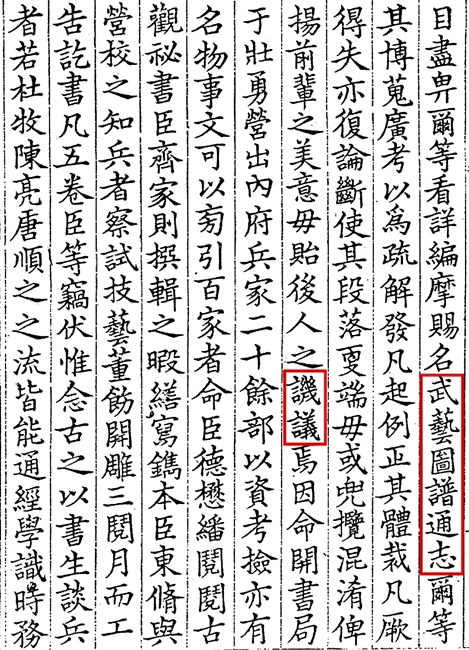
When compiling the Muye Dobo Tongji (Illustrated Manual of Martial Arts), King Jeongjo's direct instruction to his officials contained a small clue about criticism.
“I give all 24 categories of new and old martial arts methods to you all, so that you may study them thoroughly and compile them under the name 'Muye Dobo Tongji (Illustrated Manual of Martial Arts).' You must widely gather materials and broadly conduct research and verification, properly formulate the general principles, and correct the system. You must weigh the merits and demerits, redo the judgment and discussion, and refrain from changing the wording of each section. Prevent any attempt to sow doubt or create confusion, thereby elevating the beautiful intentions of your predecessors and refrain from doing things worthy of criticism by posterity.”
King Jeongjo incorporated discussions of past, present, and future even in the martial arts manual for military training. Summarizing his admonitions yields the following. First, one must not alter the content or meaning based on the gains and losses of those writing the martial arts manual in the present. Second, during the compilation process, one must prevent attempts to sow doubt or create confusion, thereby elevating the beautiful intentions of (warrior) predecessors. Third, and finally, refrain from doing things worthy of criticism by posterity.
In this way, he emphasized that the perspective of 'the present' should not remain confined to immediate reality, but rather employ a long-term vision connecting past and future when compiling the Muye Dobo Tongji. Therein lay the standard of criticism that the 'values' expressed by 'past' predecessors through their bodies must be fully conveyed. And it speaks to the need to faithfully capture 'the present' so as not to be 'criticized' by future people. Criticism is not confined to one's own era but must be approached carefully while comprehensively examining past, present, and future together.
The war Russia has waged by mobilizing mighty military force will, though delicately put, become a target of fatal criticism by posterity. That war contains neither longing for the past nor consideration for the future—only Russia's present hegemonic ambitions.
The Republic of Korea has advanced beyond the feudal era of Joseon, crossed the imperial era, and developed into a democratic republic. We who live 'today,' 'now,' must always remain vigilant and ever vigilant about the beautiful philosophy our predecessors sought to preserve and the ideology we will leave for future posterity. As King Jeongjo commanded, it is best not to do things worthy of criticism by posterity.