Kim Woo-young's Gwanggyo Column I Met My Youth from the 1980s at Suwon Museum's Special Exhibition "That Year, We Were"
I received a call from Lee Yong-chang, a senior from the Hwaseong Research Association and a photographer.
"What are you up to today? Lee Dong-geun, the team leader at Suwon Museum, really wants you to come see the photo exhibition with us."
Lee Yong-chang was my high school senior. He worked in the photography department at Suwon City Hall for a long time. He retired about ten or so years ago.
I love his photographs. He doesn't imitate so-called "artists." He captures things as they are without showing off petty techniques. No matter how long you look at them, you don't get tired of them. (Especially, I like them even more because I can also use them in my articles and columns)
That day, I was hesitant to make time because I had so much work to do all day long. Nevertheless, I hurried to finish my writing (postponing some) and headed to Suwon Museum.
There were so many people already there that there was no place to sit. Many members of the Hwaseong Research Association were also noticeable. Among them, directors Lee Yong-chang, Han Jeong-gyou, and Yun Ui-young participated in this photo exhibition.
The opening ceremony began with skillful hosting by Lee Dong-geun, the curator team leader.
This team leader is a junior scholar I like. I am also acquainted with his father, Lee Sung-ryong, a scholar who was involved in theater and served as the director of the Gyeonggi Province branch of the Korean Theater Association.
The team leader has achieved notable results through research on the March 1st Movement history in the Suwon area and the footsteps of independence activists.
In particular, he made efforts to raise public awareness of the exploits of figures such as righteous gisaeng Kim Hyang-hwa and have them recognized as patriots with services to independence.
At the opening ceremony that day, Suwon Mayor Lee Jae-jun, National Assembly Member Kim Jun-hyuk, City Council Chairman Lee Jae-sik, as well as city and provincial councilors, citizens who provided photos, and their families attended, revealing deep interest in this photo exhibition.
National Assembly Member Kim Jun-hyuk gained empathy by sharing stories about playing at the construction site of the Gyeongsu Industrial Road (Route 1) and participating in protest marches in Suwon during the democratization movement of 1987.
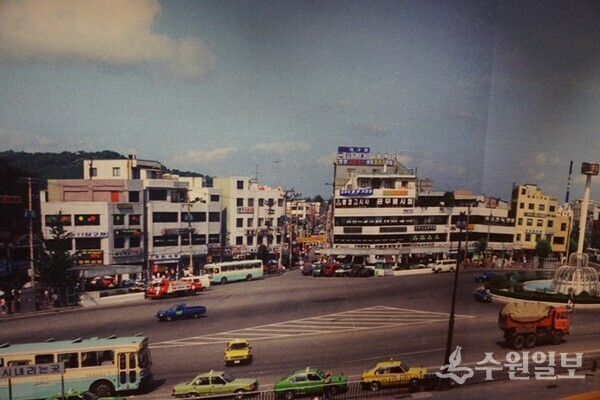
Upon entering the exhibition hall, a large panoramic photograph of the front of Suwon Station from the early 1980s unfolds. I can see the wedding venue where I held my wedding ceremony on April 19, 1981, a small cinema, a cabaret, a bowling alley, and a fountain. The old metro station stairs and clock tower are also visible. The meeting place at Suwon Station was always at the clock tower. Just like the Central Theater at Paldalmun.
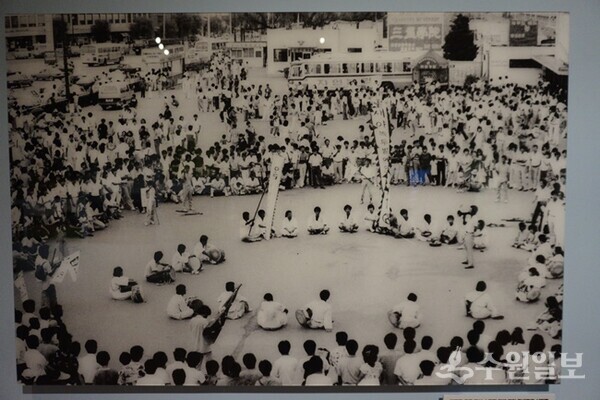
Among the many photographs that awakened memories, what held my gaze for the longest was a single black-and-white photograph. It was a scene captured in June 1987 of students and citizens gathered in a circle at Suwon Station Square during the democratization movement (June Democratic Struggle). I was one of them.
When the Chun Doo-hwan regime was coming to an end, the people took to the streets shouting "Abolish Constitutional Yusin" and "Overthrow Dictatorship." The people's anger reached a peak due to Chun Doo-hwan's regime's indirect election constitution and torture-related deaths.
Unable to withstand the resistance, the former regime gave in. On June 29, 1987, Roh Tae-woo, the representative of the Democratic Justice Party, announced the June 29 Declaration, stating that he would accept demands for democratization, including constitutional amendment for direct presidential election.
Another scene that caught my eye for a long time was the Paldalmun Market in February 1987. Soon after, the buildings will be demolished and the fortress walls will be restored. The buildings currently scheduled for demolition are empty.
As I was leisurely looking around, a woman who appeared to be around my age was standing in front of a photograph and someone who appeared to be her daughter was continuously taking pictures with her mobile phone. It was a photograph showing a man and woman posing in front of Hwahongmun. When I asked, the woman in the photo said it was her. The man was her biological brother. About 40 years had passed between then and now.
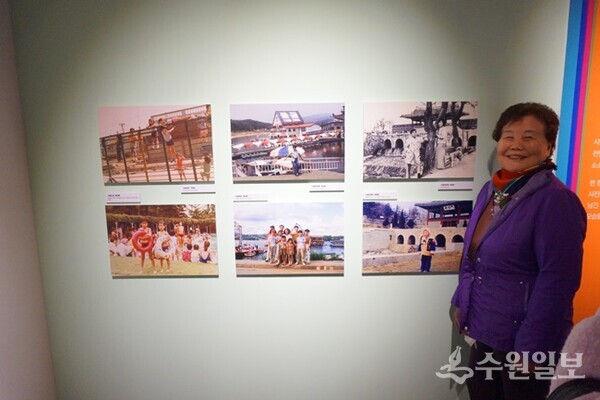
At the old Suwon photo exhibition "Suwon in the 1980s, That Year, We Were," one can see at a glance the affectionate scenery of Suwon in the 1980s and vivid records of the people who lived in that era.
This photo exhibition, which runs from March 26 to August 30 in the Special Exhibition Hall on the first floor of the museum, consists of three sub-themes: ▲That Year, Suwon's Scenery ▲That Year, Suwon's People ▲Full-Color Records of Suwon's People.
Team Leader Lee Dong-geun said, "The exhibition broadly encompasses everyday spaces such as changed streets, alleyways, traditional markets, and schools, as well as scenes capturing significant moments of the era, including the Hwahong Cultural Festival, the 1986 Asian Games, and the 1988 Olympics," and particularly emphasized that "the exhibition was completed with citizens directly providing photographs from their albums and participating as subjects of the record."
I didn't have time that day to look carefully. I must make time to revisit soon. I need to reminisce about my youth.