Port Special Young Pyeongtaek-Dangjin Port Opens Horizons for West Coast Logistics—39 Years After Opening
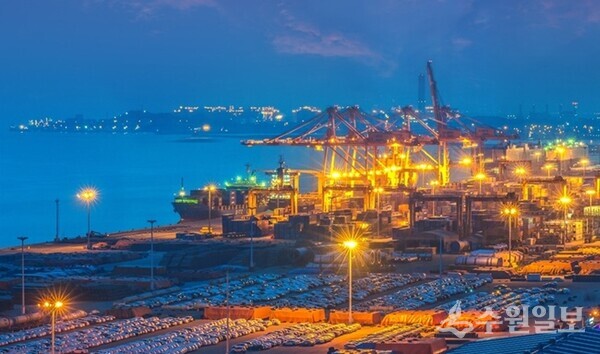
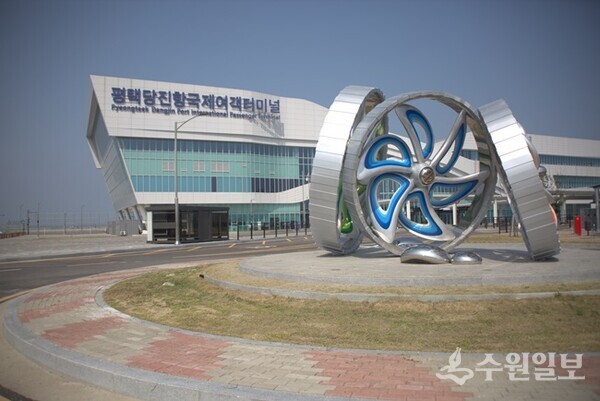
[News S = Senior Reporter Kim Jong-sik] Pyeongtaek-Dangjin Port, which opened as an international trade port with the arrival of an LNG carrier in November 1986, marks its 39th anniversary of opening. Starting as an industrial port supporting Incheon Port, the journey Pyeongtaek-Dangjin Port has traveled over 39 years is itself a story of "compressed growth" as an industrial port. Cargo volume has increased nearly 60-fold, and shipping routes have expanded into a "central node" connecting Southeast Asia, China, and Japan. The wharves have undergone successive expansions—Dolphin Wharf, East Wharf, West Wharf, Godae Wharf, Songak Wharf, and International Passenger Terminal—broadening its logistics spectrum. Living up to its name as a "young port," Pyeongtaek-Dangjin Port is preparing another transformation into a hydrogen-focused, eco-friendly, and Landbridge hub port.
◇ Growing into a West Coast Hub Port
The growth of Pyeongtaek-Dangjin Port is proven by cargo volume, the fundamental indicator of a port.
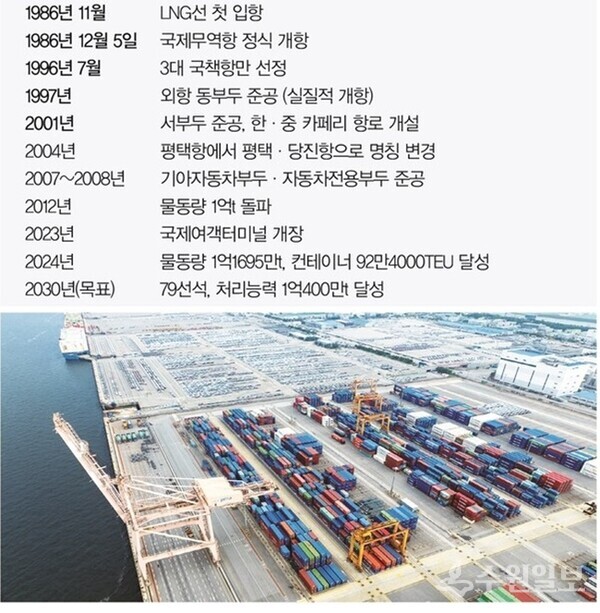
In the 1980s and early 1990s, annual cargo volume did not reach 1.98 million tons, but by the end of 2024, it had explosively increased to 116.95 million tons.
Containers increased more than 900-fold, from 988 TEU in 2000 to 924,000 TEU in 2024.
The completion of the West Wharf in 2001, Hyundai Steel's steel cargo wharf in 2007, and two Kia Automotive wharves and one dedicated automotive wharf in East Wharf during 2007-2008 became the first turning point in Pyeongtaek-Dangjin Port's leap forward.
During the 10-year period from 2005 to 2015, Pyeongtaek-Dangjin Port achieved a high compound annual growth rate (CAGR) of 10.2%, significantly outpacing Busan Port's 5.2%, Incheon Port's 2.5%, and Gwangyang Port's 4.4%.
By achieving cargo volume of 100.712 million tons in 2012 and continuing steady increases, it solidified its status as a key port in the western coastal region.
Particularly in automobiles, it has become specialized as the nation's number-one import-export port and established itself as a logistics hub connecting Korea, China, and Japan.
This is not merely a "volume increase" but rather a result where port structure specialization, infrastructure investment, and new port area expansion are interlocked in growth.
◇ Expanding Shipping Routes…'Silk Road Hub' Connecting China and Southeast Asia
The second pillar of Pyeongtaek-Dangjin Port's competitiveness is the expansion of shipping routes.
During the era of rapid Korea-China trade growth, regular shipping routes connecting multiple ports in Shandong Peninsula and Liaoning Province with Pyeongtaek-Dangjin Port simultaneously realized companies' "time savings" and "cost optimization."
Following the opening of Southeast Asian routes, the port's logistics landscape expanded further.
As container and bulk logistics with Vietnam, Thailand, and the Philippines increased, the system as a "West Coast-centered international port" was completed.
Since the LNG carrier arrival in 1986 and the container vessel (Pyeongtaek-Hong Kong) arrival in 2000, regular container routes have been operated: Southeast Asian routes in 2010, car ferry service to China's Rizhao in 2011, China's Qingdao and Weifang in 2020, new container regular service calling at Japan in 2022, two new container regular routes in 2023, new container regular routes in 2024, and new container regular routes in 2025, bringing the total to 17 container routes currently in operation.
Additionally, automobile (car carrier) routes are serviced by seven shipping companies covering the entire world: Americas, Europe and Africa, China and Japan, Australia and New Zealand, Asia, Middle East, and Central and South America and the Caribbean.
New routes are being discovered, and efforts are underway to be incorporated into larger shipping alliances through transshipment network construction.
◇ Wharf Expansion and Hinterland Development…Industry and Port Growing Together
When discussing the 40-year development history of Pyeongtaek-Dangjin Port, "wharves" and "hinterland" cannot be omitted.
The wharves, starting from a single berth initially, have now been refined into segmented types including automotive, container, steel, general cargo, and Dolphin wharves.
Port area expansion—from Dolphin Wharf to East Wharf to West Wharf to Godae Wharf to Songak Wharf—was not merely a basic infrastructure expansion but a process of enhancing port functions.
Added to this, hinterland development has nurtured the entire local industrial ecosystem.
The Asan National Industrial Complex (Poseung, Bugok, Godae districts), Gyeonggi Economic Free Zone (Poseung district), and Free Economic Zone have solidified the port-manufacturing-logistics triangle and served as a "hidden engine" for Gyeonggi Province's West Coast industry.
Hinterland growth has become a driving force for expanding diversity: automobile exports, steel logistics, frozen/refrigerated logistics, and processing/assembly-type industries.
◇ Transforming into a 'Hydrogen Port·Eco-friendly Port'
The future of Pyeongtaek-Dangjin Port centers on eco-friendliness and energy transition.
Ports are ranked as infrastructure that must change fastest in the carbon-neutral era, and Pyeongtaek-Dangjin Port has already begun laying the groundwork for a "hydrogen port."
The strategy is to transform into the "center of a West Coast hydrogen cluster" by establishing a system within the port capable of hydrogen production, storage, transportation, and utilization.
Pyeongtaek-Dangjin Port was recently designated as a hydrogen port and is currently producing hydrogen at the hydrogen transportation complex near the port.
Gyeonggi Pyeongtaek Port Authority held a forum on "Green Route Construction Strategy Following the Emergence of Eco-friendly Ships" on October 28 and unanimously agreed that Pyeongtaek-Dangjin Port should be developed as a hydrogen hub.
Shore power supply systems (APS), introduction of low-carbon equipment, and expansion of eco-friendly ship fuel supply infrastructure are being actively pursued as part of the port's transition to eco-friendliness.
This is not merely a facility expansion but an essential condition for maintaining competitiveness in future international maritime markets.
◇ Key Nodal Point of West Coast Landbridge…Capital Region, New Maritime Axis Connecting Busan Port-Pyeongtaek-Dangjin Port-China-Europe
A recently emerging topic is the "West Coast Landbridge." Just as Thailand's Landbridge project is reshaping Southeast Asian logistics, Korea is also exploring a new connection axis on the West Coast.
Pyeongtaek-Dangjin Port is at its center. Multi-modal transportation connecting China-Pyeongtaek-Southeast Asia by rail and road must be prepared from now on.
Recently, the Ministry of Land, Infrastructure and Transport and Korea Railroad Corporation launched a pilot project for international multi-modal transportation carrying cargo from Euiwang Logistics Base to Busan Port to China's Lianyungang Port to Kazakhstan, demonstrating groundbreaking results in reducing transshipment time and significantly decreasing transportation duration.
Pyeongtaek-Dangjin Port, with better geographic location than global hub Busan Port, should also prepare for multi-modal transportation utilizing the Landbridge.
◇ 40 Years of a Young Port, and What Lies Ahead?
The past 40 years of Pyeongtaek-Dangjin Port have been a time of "laying foundations." A port is not completed by a single development.
Growth, land acquisition, wharf expansion, shipping route opening, hinterland development, and repeated evolution connecting with industry at large must continue.
Pyeongtaek-Dangjin Port is the case that most compactly demonstrates this process.
Now Pyeongtaek-Dangjin Port stands at another starting point. Eco-friendliness, digitalization, hydrogen energy, specialized automotive port, West Coast Landbridge… When these future strategies are fully integrated, Pyeongtaek-Dangjin Port will leap not as a simple "regional port" but as a full-fledged international hub moving Northeast Asia's logistics.
The West Coast's youngest port, Pyeongtaek-Dangjin Port. Its 40-year record is not an ending but the beginning of a new voyage.