Choi Hyung-kuk's Sword Stroke (18) Official Yi Deok-mu Collapses from Overwork
A Fool Who Only Reads Books, Authenticating the 'Martial Arts Illustrated Guide'
Cheongjanggwan (靑莊館) Yi Deok-mu (李德懋: 1741-1793). Born as a seoal (illegitimate son of a yangban), he did not receive proper recognition at first, but his life flourished after meeting King Jeongjo. In particular, when compiling the 'Martial Arts Illustrated Guide,' he conducted meticulous research by examining not only various Chinese military treatises but also Japanese martial arts texts firsthand. Yi Deok-mu's nickname was 'Ganseo-chi (看書癡)'—he called himself a fool who only reads books.
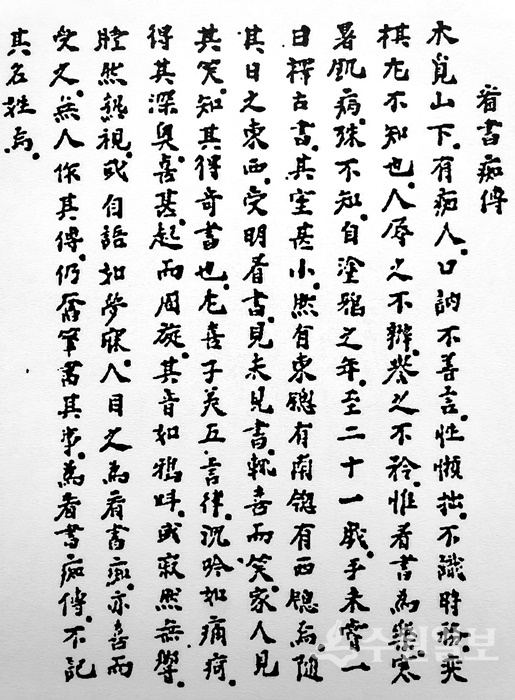
In his collected writings, 'The Complete Works of Cheongjanggwan (靑莊館全書),' there is a piece written as if introducing himself through the eyes of a third party. The title is "A Biography of the Book-Reading Fool (看書痴傳)." Since the text is not lengthy, it reads as follows.
"Beneath Mokbek Mountain (a former name for Namsan in Seoul), there lived a foolish man who was inarticulate and spoke poorly. His disposition was vulgar and lazy; he knew nothing of worldly affairs and even less of go or chess. When others cursed him, he made no excuse; when praised, he harbored no pride. He found joy only in reading books and was entirely oblivious to cold, heat, or hunger. From childhood until he reached twenty-one, he never once set down an ancient text. His room was very small, yet it had east, south, and west windows, and he would follow the sun's movement from east to west to read in the light. Whenever he saw an unseen book, he would suddenly laugh with joy, and his household knew from his laughter that he had acquired a rare volume. He was especially fond of five-character regulated verse by Zimi (the courtesy name of Du Fu, a Tang dynasty poet), and would hum like someone afflicted with illness. When he pondered deeply and grasped a profound meaning, he would be overjoyed, repeatedly standing and pacing back and forth, his movements sounding like the cry of a magpie. Sometimes he would sit quietly with eyes wide open, staring distantly, and sometimes he would mutter to himself like a dreamer. People would point at him and call him 'Book-Reading Fool (看書癡),' and he would smile and accept it. Since no one wrote his biography, I picked up my brush to write of these matters, creating 'A Biography of the Book-Reading Fool,' and I do not record his name."
With the sun rising in the east and setting in the west, he would chase the sun's movement within his room while reading books—one could say it was simply his daily life, never parting from books. His joy in reading was so deep that he forgot even cold and hunger. My own pen name, 'Zhige-chi (止戈痴)—a fool who knows only martial arts'—was actually adopted in admiration of Yi Deok-mu.
Such rumors often reached beyond the marketplace to the king's ears. King Jeongjo, who worked hard to find talented individuals around him, naturally turned his attention to Yi Deok-mu and his friends. Those called the Northern Learning faction (北學派), including Bak Je-ga and Yu Deuk-gong, were people who directly experienced Qing culture with their own eyes and devoted themselves to the cultural development of Joseon. Among them, Baek Dong-soo (白東修), who was skilled in martial arts, took charge of authenticating the martial arts techniques in the 'Martial Arts Illustrated Guide,' and he was Yi Deok-mu's brother-in-law. Since Baek Dong-soo's older sister married Yi Deok-mu, naturally his friends and Baek Dong-soo found themselves in the same circle.
The place where they gathered was around the ten-story stone pagoda at Wongaksa site, now called Pagoda Park. Today it is darkened by automobile exhaust and other pollution, and confined behind glass to avoid attacks from numerous pigeons, but at that time the pagoda was white. Thus they were called the 'White Pagoda Faction (白塔派).' Though their lives were complicated, most of them were people who studied and discussed new scholarship called the 'Northern Learning faction' despite the status limitation of being 'seoal' and dreamed of the future.
The Book-Reading Fool Meets King Jeongjo
Among them, Yi Deok-mu especially caught King Jeongjo's eye. Like Jeongjo, he loved books and possessed encyclopedic knowledge. Even a brief exchange would leave an impression. Thus Yi Deok-mu became a Gyujanggak Jeomseogwan (Checking Official at the Royal Library) at the Gyujanggak (奎章閣), an academic institution created by Jeongjo. The Gyujanggak was established in September 1776 when Jeongjo ascended the throne, symbolizing literary governance (文治). The position of Jeomseogwan was its core.
On March 27, 1779, Jeongjo established the new system of Jeomseogwan and examined talents. In fact, he created the position of 'Jeomseogwan' to embrace outstanding individuals like Yi Deok-mu and others, who, though seoal, possessed exceptional abilities. Thus four seoal of outstanding literary talent were selected.
In the 'Comprehensive Legal Code' (大全通編), newly created during Jeongjo's reign, it states: 'There shall be four Jeomseogwan at rank 5 Chamoee (參外).' Since rank 6 was typically the grade for local officials, this was exceptional treatment. To be appointed rank 5 as a Gyujanggak Jeomseogwan, even after top success in the civil service examination, was remarkable. Thus, in June 1779, the first Jeomseogwan to enter the Gyujanggak were Yi Deok-mu, Yu Deuk-gong, Bak Je-ga, and Seo I-su—all renowned as the finest scholars of their time despite being seoal. Among them, Yi Deok-mu was the oldest at thirty-nine, while Yu Deuk-gong (31), Seo I-su (30), and Bak Je-ga (29) were contemporaries.
The term of office for Jeomseogwan was thirty months. However, when the term expired, not all simply left. Two of them were arbitrarily selected by the Hongmungwan (Hall of Worthies) and appointed as concurrent Jeomseogwan (兼檢書官), operating in the form of rotation positions (遞兒職). In particular, concurrent Jeomseogwan positions had no fixed quota, so the number could continue to increase. In this way, the status of Jeomseogwan with the limitation of being seoal was secured.
However, it was too difficult to keep pace with Jeongjo's ambitions. Examining the 'Daily Records (日省錄),' from June 1790, Yi Deok-mu had to serve night duty (入直) nearly daily to handle affairs. Yi Deok-mu was noted by those around him as having such frail health that 'his body barely sustained itself.' Nevertheless, he told himself that the fine position granted by the king was no different from passing the civil service examination, and he worked diligently.
He found spiritual peace in the Gyujanggak through reading numerous books. In his youth, his mind was rich but he could not escape the chains of poverty. How dire was his situation that he once sold the seven volumes of 'Mencius' (孟子) he was reading to have a full meal, and even boasted of this to Yu Deuk-gong. Hearing this story, Yu Deuk-gong, who was also poor and had endured long hunger, sold his copy of the 'Spring and Autumn Annals with Zuozhuan (春秋左氏傳)' to drink with him.
What they said next was remarkable. They praised the two saying, "Mencius prepared the rice and Zuo Qiuming offered the wine," and Yi Deok-mu conveyed this story to his longtime friend Yi Seo-gu in a letter. Whether then or now, those studying the humanities faced similar hunger. If one fails to establish a place in academia, no matter how outstanding the research or how original the work pursued throughout life, starvation is all too likely.
In such circumstances, how grateful Yi Deok-mu must have been that the king granted him the position of Jeomseogwan. Hearing that Yi Deok-mu and Yu Deuk-gong had become Jeomseogwan, their mentor Yeonam Bak Ji-won wrote to Hong Dae-yong, "Now they will not starve to death," expressing his relief.
Thus Yi Deok-mu, who had worked so diligently to support Jeongjo's intellectual endeavors, died of overwork. It was the morning of January 25, 1793. The life of the fool who only read books ended at fifty-one, never a long span. His collected writings, 'The Complete Works of Cheongjanggwan,' contain an enormous volume of thirty-three volumes and seventy-one works. What is regrettable is that most were written before he turned thirty. After thirty, most writings were primarily of an academic nature, and after taking office as Jeomseogwan, only books compiled by royal order from Jeongjo remain.
In April 1795, Jeongjo specially appointed Yi Deok-mu's son Yi Gwang-gyu (李光葵) as Jeomseogwan and bestowed 500 nyang from funds stored in the Gyujanggak to enable the publication of Yi Deok-mu's collected writings. With such scholarly legacy, his grandson Yi Gyu-gyeong (李圭景) was able to write 'Comprehensive Annotated Collection of Global Discourse (五洲衍文長箋散稿),' an enormous encyclopedic work.
Looking at Yi Deok-mu's life, one cannot shake off a sense of regret. For me, who studies the unique subject of 'martial arts' from a humanities perspective, his life does not remain merely a figure of the past. Rather, amid this overflow of 'humanities enthusiasm,' I cannot help but notice the persistent reality that humanities scholars themselves must worry about their livelihoods.